
How to Stop Mould in a UK Rental Bedroom

Have you ever woken up in the morning and seen little drops of water on your window or touched the window and felt water on your hand Or have you ever moved a wardrobe or some furniture for some job and been shocked to see black mould spread across the wall behind it and felt worried about how it got there And what do you do.
You buy a mould spray from the shop and clean the mould off and it does look clean at the time but a couple of weeks later you notice the mould has come back Then you wonder why the mould keeps coming back Is it your fault Is there a problem with the house? Or is it just the UK cold causing it
If you’re worried about window condensation, damp patches, a musty smell or mould that keeps coming back in your rental bedroom the first thing to do is stop blaming yourself.But there’s an important thing about UK homes that most people only understand once the mould has already come back.Cleaning mould and stopping mould are two different things.
You can clean the wall as many times as you like but if the source of moisture in the room isn’t controlled the ventilation isn’t right or the wall or window has an underlying damp problem the mould will show up again even after you’ve cleaned it.
There’s another important question in UK rental properties. Whose job is it, really and at what point should we be asking the landlord to investigate the problem?We’ll clear up this confusion in this guide too in simple language and look at which law lets us get our landlord to sort this problem out.
You’ll learn why mould forms in a UK rental bedroom how to reduce condensation what the practical steps are for cleaning mould safely and what steps stop it coming back You’ll also learn when mould coming back again and again isn’t just a cleaning issue but might point to a bigger property or repair problem. And if mould keeps coming back in your bedroom don’t just spray it and ignore it The problem might be bigger than the mould itself. I’ll share the exact method I used to get rid of mould in my own rental flat.
Quick Answer: In a UK rental bedroom, mould is usually caused by condensation, when warm, moist air hits a cold wall or window. If the mould is in one fixed spot like near the ceiling or in a corner there’s a good chance it’s penetrating damp. If it only appears at the bottom of a ground floor wall that’s rising damp. Most cases are condensation, and can be fixed with proper ventilation, heating, and a dehumidifier. If the problem turns out to be structural it’s your landlord’s responsibility under the Landlord and Tenant Act 1985.
Is It Condensation, Damp, or a Building Problem?
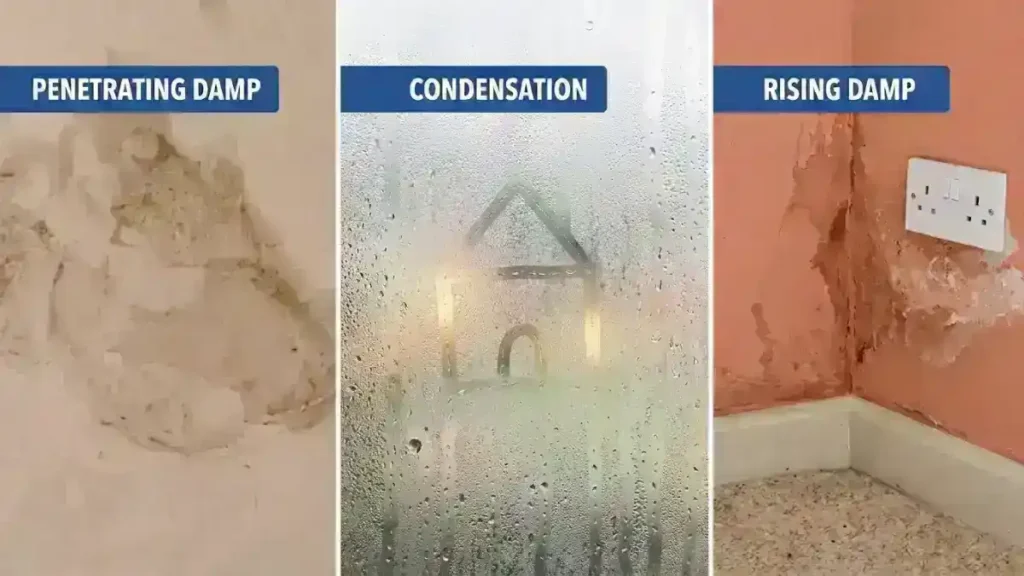
The first thing we need to understand is what type of mould you have in your room or home because the solution is different for each type.
Condensation: Most mould in homes forms because of condensation. This happens when warm or moist air (from breathing, cooking, or having a shower) hits a cold surface like a window pane or an external wall, and turns into tiny water droplets. This is the most common type. It’s the cause behind 80 to 90 percent of cases And the good news is you can control it yourself.
Penetrating Damp: This happens when water from outside is coming straight into the house including rainwater, such as through a leak in the roof or a crack in the wall. You can spot it because it usually appears in one fixed spot, like a corner or near the ceiling and it becomes more visible right after rain. This is a structural issue and you’ll need to get the landlord involved.
Rising Damp: This is very rare and much less common than people think. It’s the least common type, but the most overestimated. Building surveyors often say that most people who think they have rising damp actually have condensation. Real rising damp only affects the very bottom part of ground floor walls and it only happens when the ground floor wall draws water up from the ground beneath it. You can spot it by a “tide mark” pattern right at the bottom of the wall.
How to Tell if Mould Is Caused by Condensation, Damp, or a Leak
Signs of Condensation
Where it happens: On the window glass, around the window frame, or on any cold surface (like the corner of an external wall, or behind a wardrobe pushed against the wall)
What it looks like: Tiny water droplets on the window, or a light misty film on the glass
When it’s worst: Especially in the morning, and mostly in winter
Pattern: It can cover the whole window or appear in more than one spot not just one fixed place and it can turn up in different places
Simple way to tell: If you run your finger along the window and your hand feels wet or you see tiny water droplets on the glass first thing in the morning there’s a 99 percent chance it’s condensation
Signs of Penetrating Damp (a Leak)
Where it happens: Near the ceiling, in a corner, somewhere a pipe runs above it or on an external wall that has cracked
What it looks like: It has one fixed spot like a brown or yellowish stain on the wall with edges that look spread out as if water has soaked through. If you touch it that spot might feel slightly damp or soft
When it’s worst: It gets worse straight after rain. If you’ve noticed the patch getting bigger the day after heavy rain outside, that confirms it’s a leak
Pattern: It always stays in the same spot on the wall or ceiling It doesn’t spread across the whole wall it just keeps growing in that one place
Simple way to tell: If the mould is in one corner or near the ceiling, and gets worse after rain, it’s a leak, and the smell is usually a bit stronger too spreading more right after rain. So tell your landlord straight away
Signs of Rising Damp (the Least Common Type)
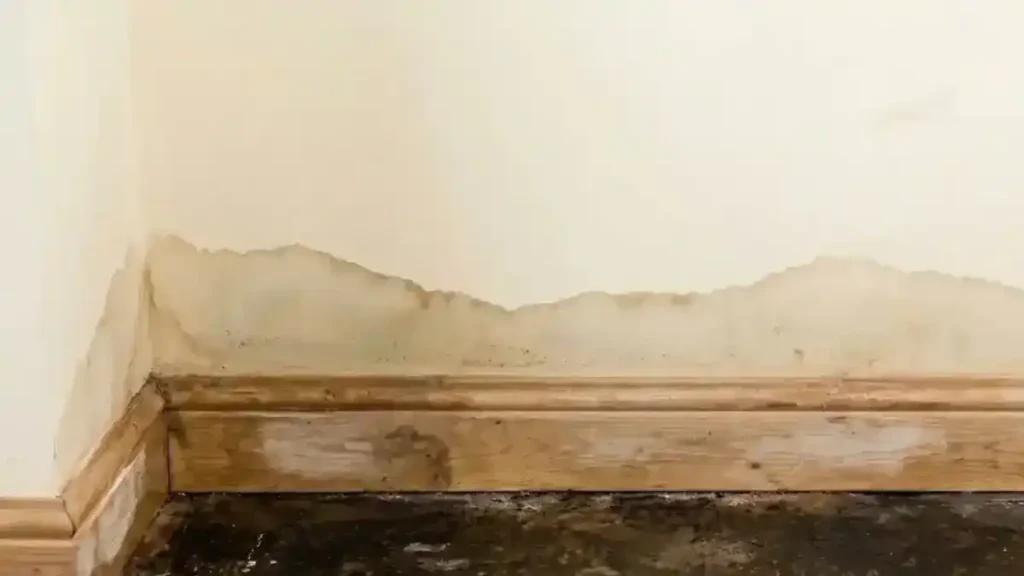
Where it happens: Only in the very bottom part of ground floor walls (up to about a metre from the ground)
What it looks like: A line like a “tide mark” just like the mark left by water on a beach. The paint or wallpaper on the wall might also be peeling from the bottom
When it’s worst: It’s not really linked to the weather, it just stays there wherever it is
Simple way to tell: If you live on the first floor or higher, you can’t have this at all, it’s only a ground floor problem so there’s no need to worry much about it
| Type | How to Spot It | When It’s Worst |
| Condensation | Small water droplets on windows or cold walls | Stays the same, not linked to weather |
| Penetrating Damp | A fixed brown or dark patch, often near a corner or ceiling | Right after rain |
| Rising Damp | A tide mark line at the bottom of a wall | Stays the same not linked to weather |
Mould on One Wall Only Cold Wall or Poor Insulation?
If mould is only forming on one external wall, you can’t call it condensation, because if it were condensation it would be happening across the whole room not just on one wall. This confuses a lot of renters. First, we need to understand why it’s happening on just that one wall.
First, we need to understand what insulation actually is. Insulation is a layer fitted inside a wall, floor, or roof (made from something like foam or fibreglass) and its job is to keep heat in and cold out. The better the insulation the less cold the wall stays despite the cold outside. Having strong insulation is the most important thing here.
If three walls of your room are attached to another room (where there’s already heat from that other room), and only one wall is external (facing the cold outside directly), that wall will be colder than the other three if its insulation is weak or missing.
This problem is very common in older buildings and it’s very common in UK buildings especially Victorian or pre 1980s properties because at that time building regulations weren’t as strict about insulation as they are today. If your wall is “solid brick” (rather than a double wall cavity) it’s practically the same as having no insulation at all and the good news is that walls like this are now quite rare.
Here’s the most important thing. If this is happening to you meaning one of your walls stays cold compared to the other three, this is a structural or building issue and it’s not your fault at all. No matter how much ventilation or heating you do if the wall itself stays cold the risk of condensation on that external wall will stay high. It becomes the landlord’s responsibility to improve the insulation or at least look into the problem further.
“This happened to me too. In one of my properties, the external bedroom wall was always noticeably colder than the other walls, and mould would form on that same wall every winter. That’s why I’m giving you this guide, because I know it firsthand.”
Mould Near the Ceiling or in a Corner, Roof Leak or Penetrating Damp?
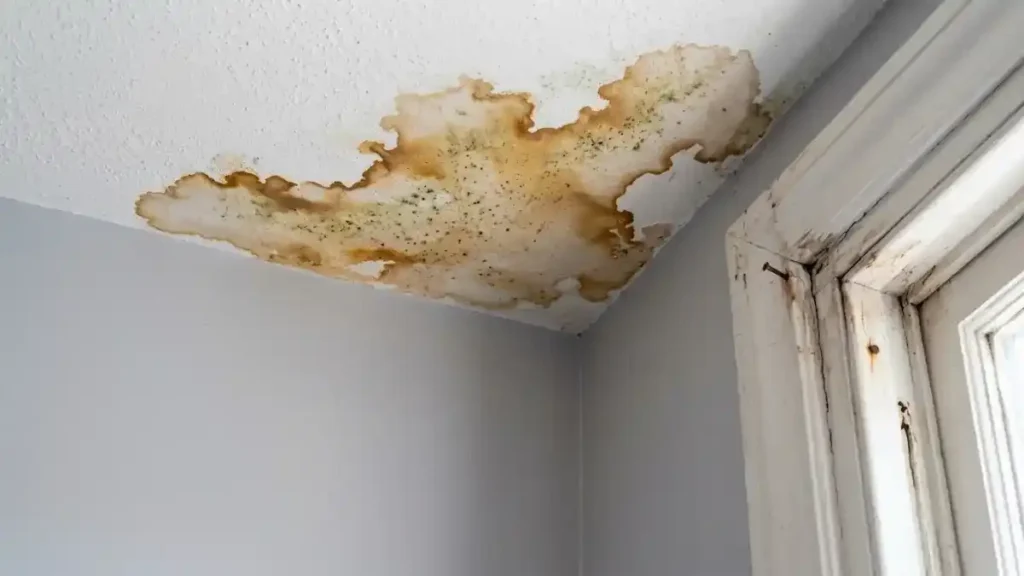
This is really important. If your mould is near the ceiling this isn’t ordinary condensation it’s something you need to tell your landlord about right away. If you see damp near the ceiling or in a corner it can’t be condensation because condensation always forms on a surface like glass or a cold wall.
Water appearing on the ceiling means there’s a leak somewhere or there could be a fault in a pipe running through the ceiling. This mostly happens on the top floor of a property, because the roof is often the first point where outside water can get in. It can also happen near a chimney. It can also happen on the ceiling right below the bathroom or kitchen of the flat above which could be a plumbing issue meaning a leak from a neighbour’s pipe but it would look exactly the same.
It can be yellowish or brown in colour, as we discussed above and it gets bigger over time especially right after heavy rain. If your room has paint on the wall the paint might bulge or crack and if there’s wallpaper it might start to peel. The smell is earthy a musty type of smell.
If you see this pattern in your room or flat tell your landlord straight away. Delaying this can lead to structural damage like the ceiling plaster weakening and falling which can become very costly and dangerous for us. So don’t delay on this.
Why Does Mould Keep Coming Back After Cleaning?
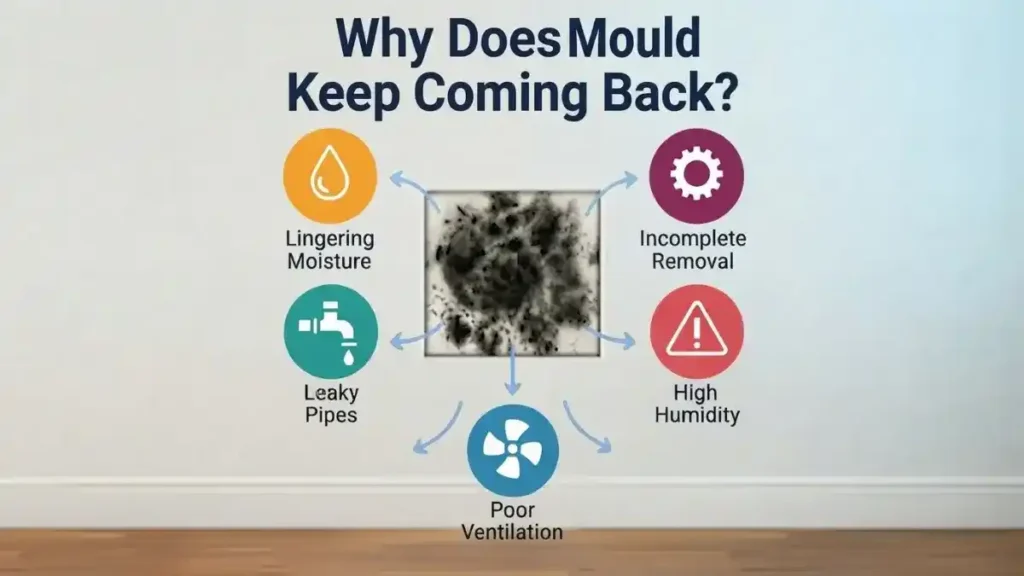
What most renters do is treat mould like a stain something you clean and it’s gone. But mould doesn’t work that way. Mould is like a result. When you clean it off with a spray, you’re only getting rid of that result but the process that’s causing it doesn’t stop at all. It’s just like water dripping onto the floor from a pipe and you’re only wiping the water off the floor instead of fixing the pipe.
Mould is the same. Wiping the water off the floor means cleaning the mould and fixing the pipe means sorting out the ventilation, heating, furniture placement, or fixing the leak. This is usually caused by three things: poor ventilation, inconsistent heating, or furniture pushed against the wall. We’ll look at these in more detail below.
I Cleaned the Mould But It’s Back Within Weeks
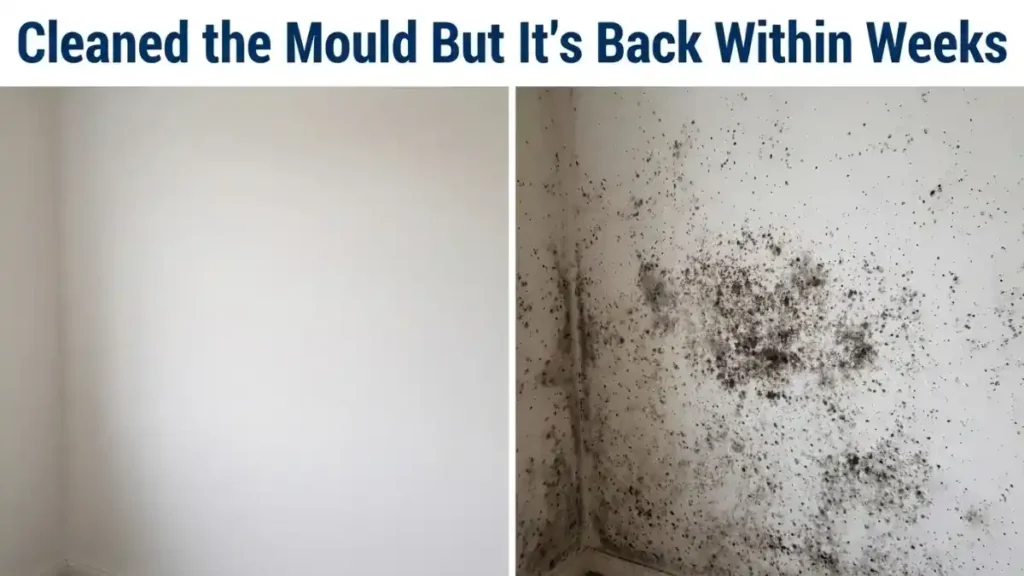
If you spray and clean the mould off, and it comes back after some time it means the damp cause behind it never really went away. So whenever you clean mould do a few extra things alongside it that will get rid of it for good in most cases as long as there isn’t a wider property issue. When you clean the mould follow this two week plan alongside it:
- Open the window daily for 10 to 15 minutes
- Keep the heater on a low, consistent level all day (don’t leave it completely off or blasting)
- Keep furniture, like a wardrobe or bed, about 2 to 3 inches away from the wall where the mould appeared
- If the mould was inside or behind a wardrobe put silica gel packs or moisture absorber boxes inside it too
If you keep doing these four things consistently for two weeks mould won’t come back in most cases.
Does Recurring Mould Mean a Bigger Property Problem?
Stop trying to fix it on your own, because trying again and again makes many renters feel guilty thinking “maybe I didn’t do it right” and they keep trying endlessly for months when they should have told the landlord much sooner. I made this same mistake myself so don’t make it too.
If you’ve tried everything opening the window for 10 minutes daily, heating consistently and keeping furniture 2 to 3 inches from the wall and you’ve kept this up for 2 to 3 weeks and mould is still appearing in your flat it means there’s an issue with the property like poor insulation a small hidden leak or a failure in the damp proofing. At this point stop spending your time money and cleaning products on it and go straight to your landlord in writing (email) about it. They should come and check it themselves and find and fix the problem.
Stopping Condensation on Bedroom Windows This Winter
The window is the coldest part of our home because the glass gets very cold from the cold outside compared to our walls. Here’s what happens When we sleep at night our breath is warm and moist our body is warm too and overall the room is warm as well. When all this warm air reaches the glass of our window it turns into tiny droplets which we see every morning and this often worries a lot of renters seeing the whole window soaking wet as if someone had sprayed water on it.
This is 100 percent normal science. It doesn’t mean there’s a problem with your home as long as this happens daily and isn’t wiped away. If this is happening on your window too follow these three steps.
- Leave the bedroom door slightly open before going to sleep at night (if there’s heating in the rest of the house too) so moisture doesn’t build up in just one place
- If your window has a trickle vent keep it open all night
- The first thing you do every morning should be wiping the window not leaving it as it is
Why Are My Windows Soaking Wet Every Morning?
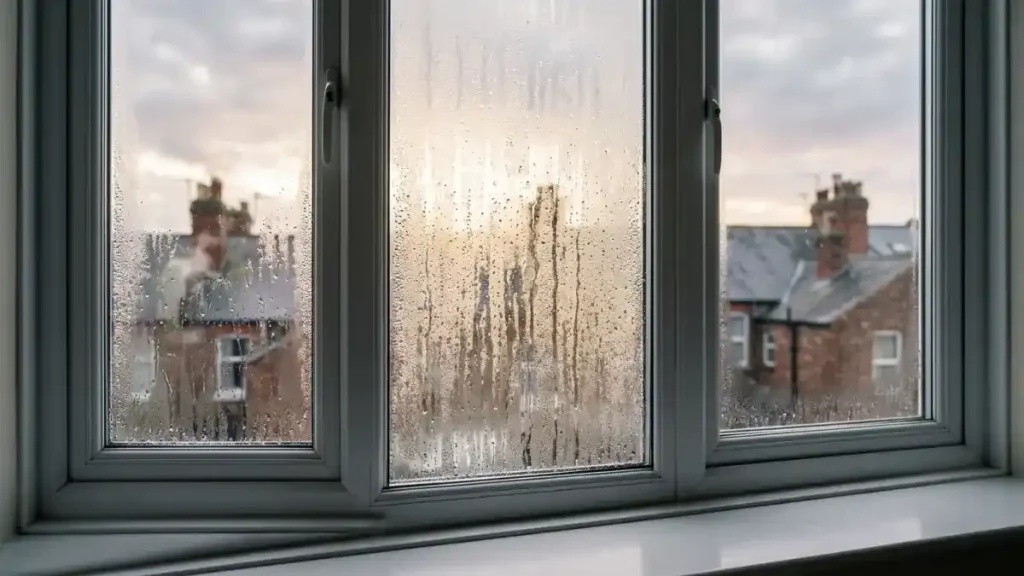
Older UK properties especially very old rental properties tend to have single glazed windows meaning just a single layer of glass whereas modern windows have double glazing with a gap between the two panes which also gives better insulation. A single glazed window gets cold much faster which means condensation forms much faster too. If your property has single glazed windows you’ll get more condensation than other people would and in this case the steps above (trickle vent, wiping) become even more important because your window can naturally stay colder. You could ask your landlord to have the windows changed too.
Black Mould Around the Window Frame Is Condensation the Cause?
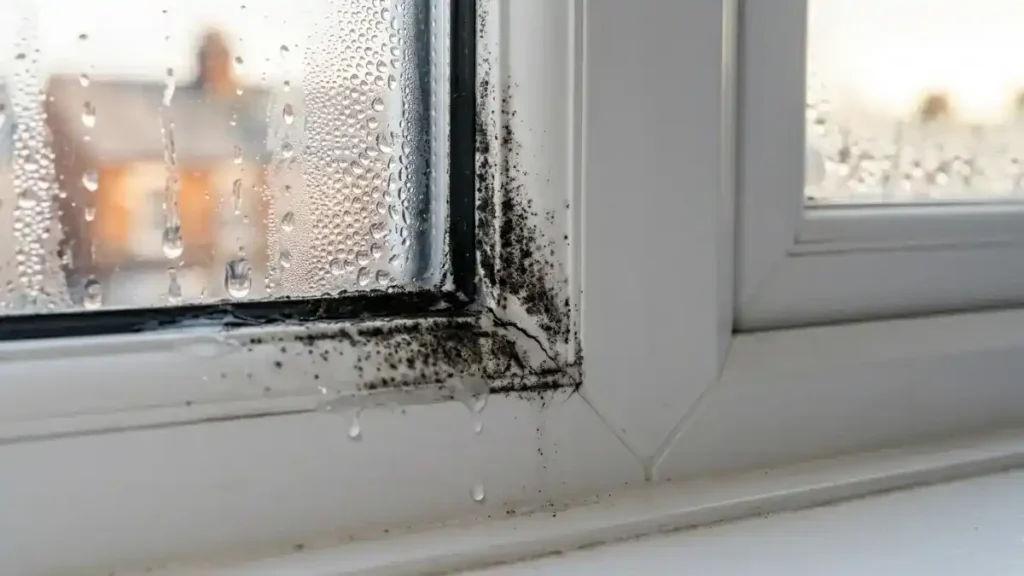
The answer is yes because if the mould is only on the window frame not the whole wall it means it’s condensation. This is because the water that collects on the window at night if it isn’t wiped away in the morning turns into mould within two to three days. Mould only takes 24 to 48 hours to form because just two days of neglect can be enough for mould to grow.
So the best solution for this is simple. Whenever you see water on the window in the morning wipe it off straight away. This only takes 30 seconds of your time and saves you from a much bigger loss. This is the simplest and completely free method but a lot of renters skip it and once the mould has formed they go and buy a spray to remove it instead which doesn’t make much difference.
Mould Behind Wardrobes, Beds & Furniture
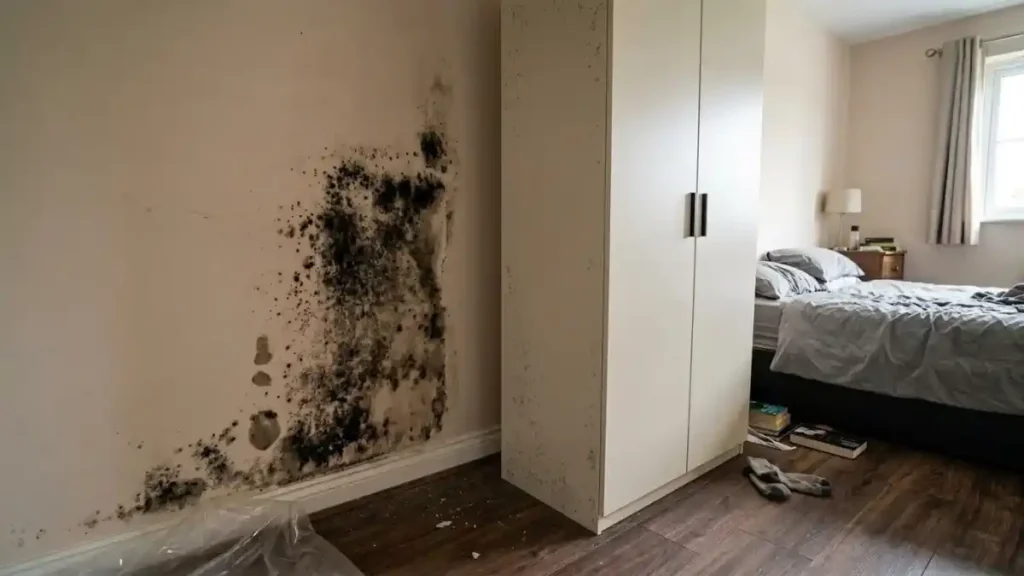
Has this ever happened to you? You moved or removed a large piece of furniture (a wardrobe or bed) from your room for some job and were shocked to see black mould wondering where it came from and how long it had been there. Mould appearing behind a wardrobe or bed is a common problem. This feeling is completely normal. The reason is quite simple. Wherever furniture is pushed right up against a wall air stops moving in and out there which means there’s basically zero ventilation in that space. So condensation which is warm air hitting a cold wall and turning into water quietly does its work there without anyone noticing until we finally look behind it.
Why Mould Appears Behind a Wardrobe Against an External Wall
To understand the answer to this we first need to understand that not every wall in a house is equally warm. Because of the cold weather an external wall is as cold on the inside as it is on the outside which is why we call it an external wall. If we push a wardrobe or any other large piece of furniture right up against this cold wall so air can’t pass through easily the room’s warm humid air gets trapped behind the wardrobe and hits that cold wall. When warm air (from breathing, or the heater running) meets the cold wall tiny drops of water start forming there which is what we call condensation.
Here’s another important point. A wardrobe is usually made of wood and wood itself absorbs a bit of moisture which makes the situation a little worse because now both the wall and the back of the wardrobe can stay damp.
How Much Space Should You Leave Between Furniture and a Wall?
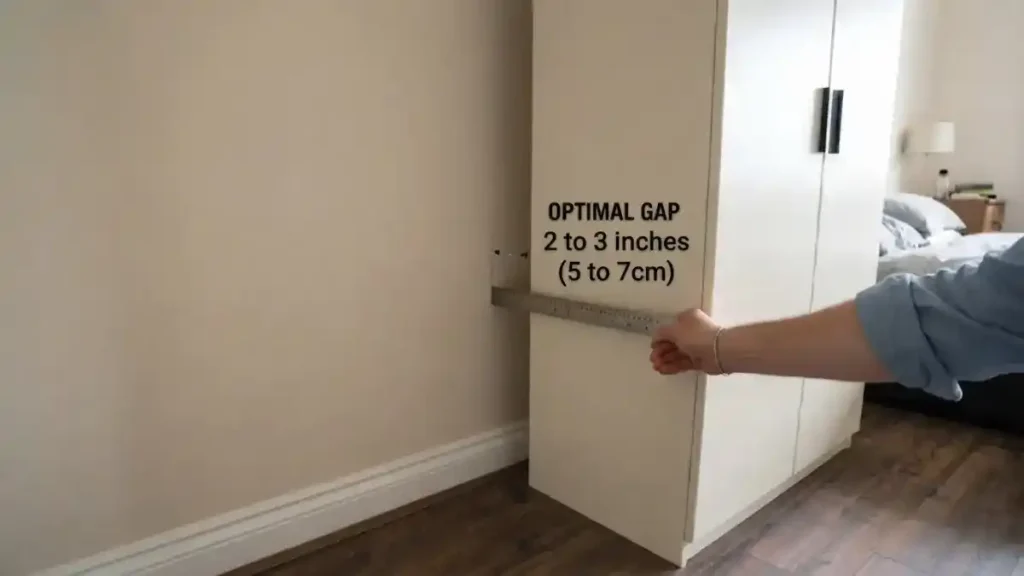
This is the most practical question people ask and the good news is the answer is really simple. Leave a gap of at least 2 to 3 inches (5 to 7 cm) between the furniture and the wall. This gap is enough for air to circulate just enough for a little air to pass through so the wall isn’t kept cold. If your bed is pushed straight against an external wall too leave the same kind of gap there as well. This advice doesn’t just come from one place it’s been confirmed by many renters and I’ve tried it myself and found it helpful so it might help you too.
Here’s a small practical tip too. If your wardrobe is already very heavy and it’s hard to move it regularly, you can fit rubber or plastic spacers in the back corners which permanently keep that gap in place.
Can Condensation Build Up Inside a Closed Wardrobe?
Yes, absolutely. Condensation (moisture building up) and mould (fungus) can form inside a closed wardrobe too. This usually happens when the air inside the wardrobe and the temperature of the room outside don’t match.
Here’s a science based fact that’s really important to understand. When the moisture level in the air of an enclosed space rises above around 60 percent humidity mould can start forming within just 24 to 48 hours. This figure is confirmed by both the US Environmental Protection Agency (EPA) and the IICRC (an international professional standard body for mould and water damage). This means it’s not a slow process that takes months. If the conditions are wrong, it can start in just 1 to 2 days.
Now the question is, where does all this moisture inside the wardrobe come from? There can be four reasons. First, if your wardrobe is against an external wall, as we discussed above. Second, if you put slightly damp clothes into the wardrobe. Third, if you pack your wardrobe so tightly with clothes that air can’t circulate at all. Last, putting clothes straight into the wardrobe right after ironing them because they still hold a bit of steam at that point which can create moisture.
The best solution for this is to keep a small gap between the wardrobe and the wall always keep clothes fully dry before storing them and use silica gel or dehumidifier bags. On top of that, open your wardrobe doors from time to time, and finally avoid overcrowding it. This way, you can avoid condensation.This way, you can avoid condensation. If your wardrobe always feels overcrowded our free wardrobe organisation hacks can help with that too.
The same problem can happen with beds and ottoman storage too. If your bed sits flat on the floor, with no legs and no gap underneath, air can’t get through there either, and your body’s warmth at night can trap a bit of moisture in that space.
Ottoman storage beds are even more at risk for this, because they’re almost sealed shut by design. No air gets in until you actually open it. If anything even slightly damp goes inside, like clothes that weren’t fully dry, mould can form within a few weeks.
So open your ottoman once a week and let it air out for a couple of hours, and if you don’t have a bed frame with legs, lift the mattress occasionally and check underneath. This is worth doing regularly, not just once.
Drying Clothes Indoors Without Causing Mould

Renters in the UK face a really important problem once winter starts: where do we dry our wet clothes?
Why does drying clothes indoors cause mould, and what’s the smart solution Before we get to the solution we need to understand where all the water from wet clothes goes when we dry them in a room. All of that water turns into water vapour and joins the air.
According to condensation guidance from official UK organisations like the Energy Saving Trust (EST), a small family’s daily laundry, once dried indoors, can release around 2 litres of water into the air.
Now imagine if that same 2 litres of water is released into a small closed room where the air can’t get out. The humidity in that room shoots up straight away. And as we discussed earlier once the humidity in a space goes above 60 percent mould can start forming within just 24 to 48 hours.
Does Drying Clothes Indoors Make Mould Worse?
The clear answer is yes. Drying clothes indoors can make mould much worse but only under one condition if the clothes are being dried in a room where the door is closed the window is closed and there’s no airflow at all. In that case, yes, it can make mould even worse because the water coming off the clothes has nowhere to go so it starts turning into condensation straight away on the walls the window glass or the back of wardrobes and beds.
If we do this the right way which we’ll go through next this risk drops a lot. This doesn’t mean drying clothes indoors is wrong, it means where and how you dry them matters most. I’ve seen a lot of renters feeling guilty, thinking their everyday need (drying clothes) is somehow the wrong thing to do when really the problem lies in the method not the activity itself.
The Safest Way to Dry Clothes Without a Tumble Dryer
Most renters or people living in small flats in the UK don’t have a tumble dryer because it takes up space and also adds a lot to the electricity bill. Here are four practical solutions anyone can use.
Run an Extra Spin Cycle: After washing your clothes run them through an extra spin cycle in the washing machine before taking them out. This gets rid of extra water in the clothes leaving them only slightly damp. The less water left in the clothes the less vapour will build up in the room which also makes the whole process faster and safer.
Use the Bathroom Extractor Fan: Most UK properties have an extractor fan fitted in the bathroom, which can make it the best place to dry clothes. Put the drying rack in the bathroom close the door, and turn the extractor fan on. The extractor fan continuously pushes moisture straight outside through the wall which is even more effective than a window because it’s removing water exactly where it’s needed most.
Leave Space Between Clothes: Don’t hang clothes on the drying rack pressed together or overlapping. Leave at least a 2 to 3 inch gap between them so air can pass through. This also stops your clothes from getting a musty smell.
Use a Portable Dehumidifier: If it’s too cold outside and opening a window isn’t practical an alternative is to keep the clothes in one specific room close that room’s door (so the moisture doesn’t spread to the rest of the house) and run a small portable dehumidifier there. This machine pulls extra water out of the air and stores it in its own tank keeping the room’s humidity under control. Small portable dehumidifiers are available in the UK at affordable prices and they’re more than enough for an average bedroom letting you easily avoid bigger problems.
Can a Clothes Airer in the Bedroom Cause Mould?
Yes, this can be really risky for both your health and for mould. Because of limited space renters in the UK often keep the drying rack in the bedroom even though the bedroom is actually the most dangerous place in the house to dry clothes.
Renters often don’t think about the fact that at night, while you’re asleep in the bedroom your own breathing is already adding moisture to the room roughly 0.5 to 1 litre of moisture. And if we dry wet clothes in that same room too the total moisture builds up a lot reaching over 70 percent. It’s this combination that makes the bedroom the riskiest place of all.
As far as possible avoid drying clothes in the bedroom. If there’s really no other option at least keep the window open and remove the clothes as soon as possible so the air in the room can return to normal helping you avoid a bigger problem. Otherwise you could end up with health issues too because mould spores and high humidity from wet clothes get breathed in while you sleep at night. This can lead to a blocked nose or sore throat first thing in the morning worsen asthma and allergies and the damp smell from the clothes can also disturb your sleep.
Do Dehumidifiers Actually Stop Mould?
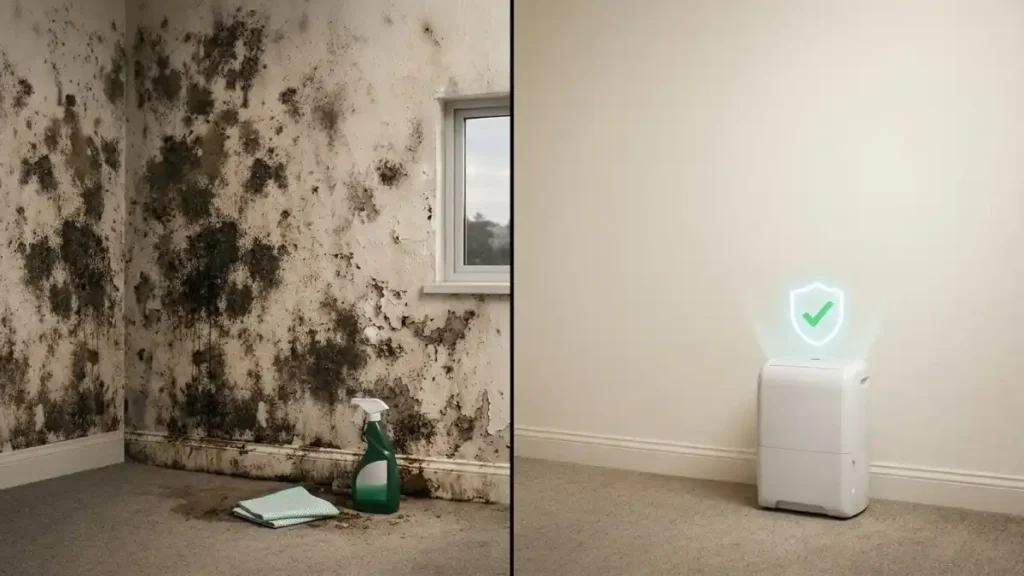
This is where renters have a big doubt and question. Does spending £100 to £200 on a dehumidifier really get rid of mould permanently or is that just a rumour And what exactly does this machine do to the air that stops the walls turning black And a really big question people ask is whether it can remove mould that’s already formed. Let’s go through this in detail.
A dehumidifier is the most effective long term solution for stopping mould. A dehumidifier is an electric machine that pulls air from the room in removes the extra moisture from it bringing the humidity down to between 40 and 50 percent and stores that extra water in a tank inside it then releases dry air back into the room. Its main job is to reduce the extra moisture in the air. I’ve tried this myself and since then my walls have stayed far safer and mould free than before.
This machine only works for condensation type mould because the root cause of condensation is too much moisture in the air. When the dehumidifier reduces that moisture condensation stops forming. But if the real cause of the mould is a water leak or a structural issue with the building (which we discussed earlier) the dehumidifier will only ease the symptom the actual cause (the leak) will stay exactly as it is and the mould will come back after a while.
If the mould in your room is due to condensation you can go ahead and buy a dehumidifier. But if the cause is a leak or a structural issue tell your landlord so they can sort the problem out properly.
Can a Dehumidifier Really Prevent Mould?
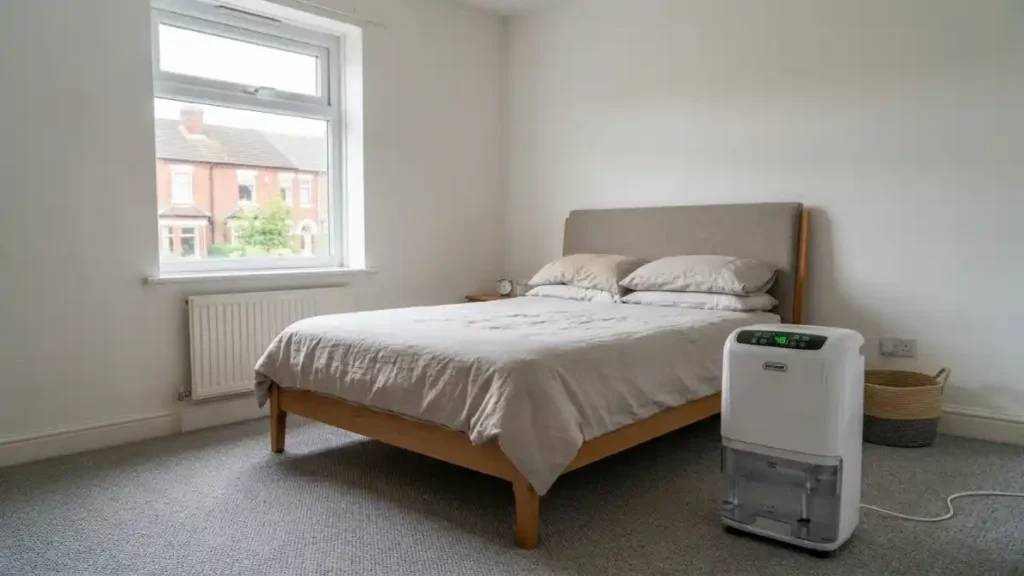
Yes, a dehumidifier can prevent mould almost completely because mould’s existence depends on moisture in the air and it’s very effective against condensation. Mould isn’t something that just appears out of thin air on its own its spores are always present in the air. These spores only need water and moisture to grow and they don’t become active until the humidity level rises above 60 percent. A dehumidifier keeps the humidity level maintained between 30 and 50 percent.
There’s another question people ask a lot too. When I first started out in the UK this was my own question as well which dehumidifier should I buy and how long should I run it for The answer is really simple. Small portable dehumidifiers are available in the UK at affordable prices and they’re more than enough for an average bedroom. You only need to run them for a few hours a day there’s no need to run them all day. I mostly ran mine at night when electricity is at off peak hours which also saves on the energy bill.
My Dehumidifier Fills Up Fast or Mould Still Returns Even With It Running What’s Going On?
If your dehumidifier’s tank is filling up very quickly, there could be three reasons for this. First, if your dehumidifier is in a small bedroom and it’s filling up much faster than normal, say within 2 to 3 hours, it means the moisture in the room is well above normal levels. This is itself a warning sign that there’s an extra source worth investigating like a small leak that hasn’t been noticed yet or very poor ventilation. Second, it could be that you’re running it across the whole flat and the dehumidifier’s tank capacity is too small to cover the whole space.
Third, it could be that when you run the dehumidifier in a room you leave the window or door open which lets it pull in damp air from outside too making the tank fill up faster. This doesn’t mean your machine is broken or faulty it’s just filling up quickly because of the environment.
If mould is still coming back even though you’re running your dehumidifier constantly this can be a very important sign because a dehumidifier can only deal with condensation. If mould is still appearing it means this isn’t condensation. Don’t spend more money on dehumidifiers or cleaning sprays now, it’s time to tell your landlord. Because if mould is still appearing despite running a dehumidifier it could mean a building leak, a roof leak, or a damp wall issue so instead of delaying tell your landlord straight away.
Heating a Cold Bedroom Without a Huge Energy Bill

The biggest problem that starts in the UK during winter is heating bills. Running full heating all day is expensive especially given current UK energy prices. But not heating at all also raises the risk of mould because warm moist air turns into water quickly on cold surfaces (as we mentioned above). So the real question isn’t whether to heat or not it’s how to heat in a way that avoids the problem without pushing the bill up too much.
Reducing Mould When You Can’t Afford to Heat All Day
I had this exact same problem myself. I couldn’t run the heating all day either because the bill would be far too high. But if we leave the heating off completely mould can appear on the wall. So there are ways to stop mould without spending too much extra on heating.
5 to 10 Minute “Shock Ventilation”: The best and free method in my view is that when you wake up in the morning open the windows across the whole room or flat for 5 to 10 minutes so the air inside and outside can exchange which brings down the chances of mould a lot.
Zone Heating (Turn Off Unused Radiators): Second turn off the radiators in areas you don’t use like the hallway and keep the radiator on only in the room where you spend most of your time or sleep and keep that room’s door closed too so all the warmth stays in that one room.
Wipe Water Off the Windowsill in the Morning: Third, when the heating is off moisture heads to the window first. So as soon as you wake up in the morning wipe away any water on the windowsill with a microfibre cloth or a window squeegee because if that water stays sitting on the glass it will evaporate back into the air and form mould on the walls again.
Low and Steady Heat (16 to 18°C): Last, and important instead of turning the heating on and off often (meaning completely off sometimes and full blast other times), it’s much better to keep it at a low steady temperature both in terms of energy use and mould prevention (something like a gentle, consistent 16 to 18°C). This matches NHS and Energy Saving Trust guidance as ideal for a bedroom at night. This range stops the walls getting cold enough for mould to form while also keeping your energy bill under control.
Mould Appearing Even Though the Room Feels Warm Why?
This is something that confuses a lot of people like one person who asked:
“I thought mould only formed in cold rooms. My bedroom is actually pretty warm and comfortable so where has this black mould come from? Does heating have nothing to do with mould at all?”
The clear answer is that even though you might think mould doesn’t appear in a warm room there are three reasons mould can still appear in a warm room that are worth knowing about.
Cold Surfaces (Cold Walls and Corners): Heating warms up the air in the room but the wall or corner that stays cold because of the cold outside will still form condensation as soon as warm moist air hits it which is what creates mould. So keep furniture 3 to 4 inches away from that wall so air can circulate there.
Dead Zones (Behind Furniture and Curtains): Warm air doesn’t reach behind wardrobes heavy curtains or beds. Cold and moisture get trapped in these “dead zones” so even though the rest of the room is warm black mould still forms behind the furniture. So open your wardrobe doors for some time during the day and if a curtain hangs over a radiator move it away from there for a while.
High Moisture in Warm Air: Warm air holds more moisture than cold air. If the humidity level is high in a warm room then as soon as the heating turns off at night all that water in the air condenses and settles on the wall.
Quick Fix: Keep heavy furniture 2 to 3 inches away from the wall, do 5 minutes of cross ventilation in the room, and control sources of high moisture.
How to Safely Clean Mould From Bedroom Walls
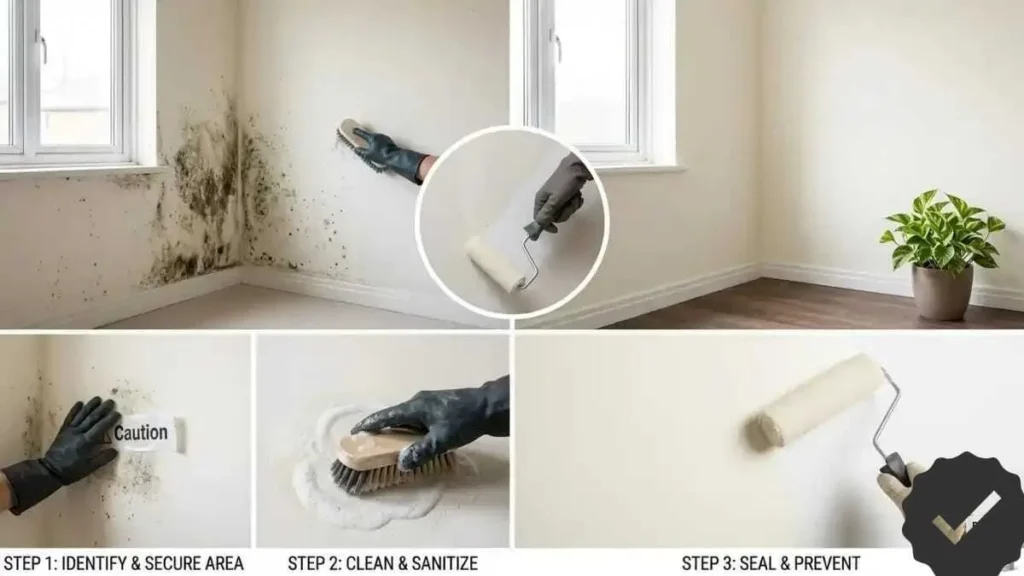
If mould has formed on your bedroom wall or any wall don’t start scrubbing it with a cloth straight away. That could be the biggest mistake you make because mould contains very tiny particles (spores) that can float into the air and spread through the whole room. On top of that cleaning it without protection or the right technique can affect your health so your safety comes first. If you want to clean your bedroom wall properly and get rid of mould at the root without causing any damage make sure to follow the verified steps and safety rules below.
The Right Way to Clean Black Mould Yourself
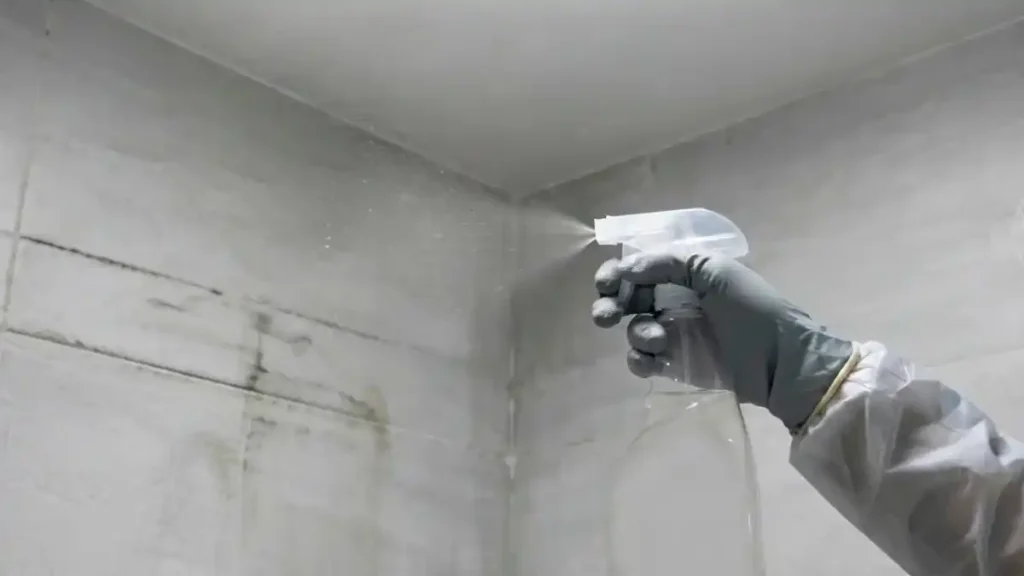
Before cleaning mould we need to protect ourselves first, so it’s essential to wear gloves, an N95 or FFP2 face mask, and goggles because when cleaning mould microscopic spores can float into the air and get into your lungs or eyes. And here’s an important point never scrub mould with a dry cloth or dry brush. Dry scrubbing can spread mould particles into the air. There are two products most commonly used to clean mould bleach and white vinegar. Let’s look at both properly since I’ve tried both myself and I’ll explain them clearly to you.
Bleach: Bleach is stronger at removing stains which is why it removes mould too and using it makes the wall look clean on the surface because bleach bleaches the surface stain white. But the mould underneath stays alive (because plasterboard walls are porous and bleach’s chemical molecule is too large to reach down into the wall and kill the mould’s roots).
If you only need to remove mould from your wall for a short time you can use bleach. Before using it wear gloves and a mask because it releases toxic fumes. Put it into a spray bottle then spray it thoroughly over the mould to soak it then leave it for 10 to 15 minutes. Then wipe it away with a disposable cloth in one direction only don’t scrub back and forth and keep the window open while you do this.
White Vinegar: White vinegar penetrates into a plaster wall and kills around 82 percent of mould species at the root, which makes it far more effective than bleach because it stops the mould coming back. Before using it wear gloves, a mask and goggles because the spores released while removing the mould can cause harm especially to people with asthma or allergies. Follow this simple step by step method to remove it:
Take an empty spray bottle and fill it with 100 percent undiluted white vinegar without mixing in any water. Then spray it thoroughly over the areas where the mould has formed. Then leave it for at least 1 hour so it can reach down and kill the roots inside the wall. After 1 hour take a lightly damp microfibre cloth or a cloth wrung out in warm soapy water and gently wipe the mould away (remember don’t scrub with a dry cloth).
Then put the cloth you used to clean the mould straight into a plastic bag and throw it in the bin (or wash it in hot water). After that open the room’s window or run a fan or dehumidifier to let the wall dry out completely.
Warning: Never mix bleach with vinegar or ammonia, it creates a harmful gas.
Is Repainting Over Mould Enough?
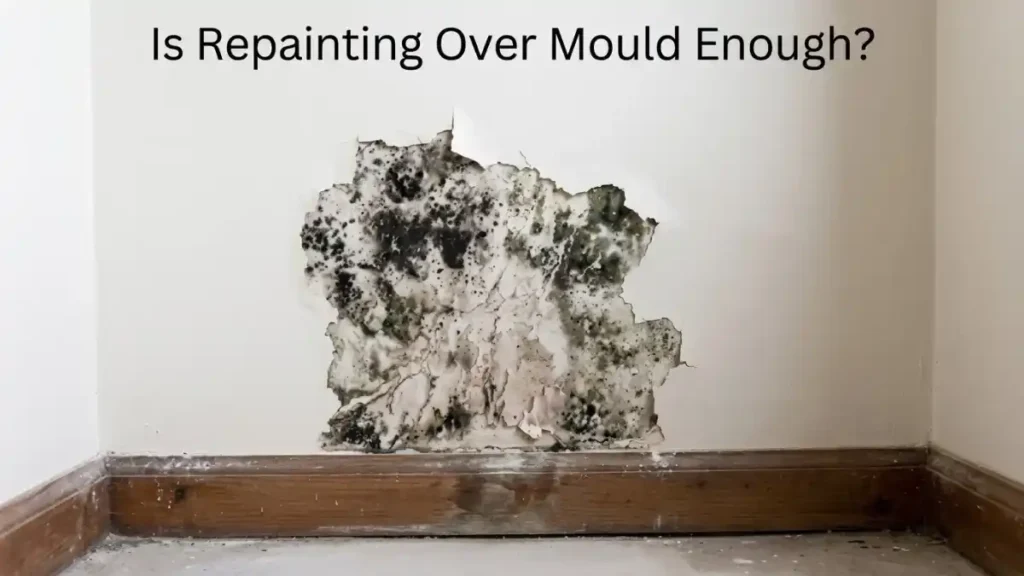
The clear answer is no definitely not. Painting directly over mould wastes both money and time. If your wall has moisture in it and you paint over it without properly killing the mould first the paint will lift and the mould will reappear within a few days. This isn’t a proper fix.
Cleaning mould off hard surfaces (like tiles or glass) removes the stain straight away but a bedroom’s plaster wall or drywall is porous meaning mould can put down roots inside it. Spraying white vinegar kills the mould but a light grey shadow (a mould stain) can be left on the wall. If a grey mark is left after cleaning but it isn’t spreading there’s no fuzz on it and there’s no smell coming from it don’t worry it means the mould is dead it’s just a pigment stain.
You can paint over it but before painting apply a coat of stain blocking primer (like Zinsser Cover Stain or Polycell Stain Block). After that once you apply normal paint or anti mould paint the wall will look completely new and clean.
UK Renters’ Tip: If the mould patch is smaller than 1 metre by 1 metre and you’ve killed it with vinegar and touched it up with the original paint you don’t need to tell your landlord. Under standard UK tenancy rules it’s the tenant’s responsibility to restore the property to its original condition which also keeps your deposit safe.
When Mould Covers a Large Area Call a Professional
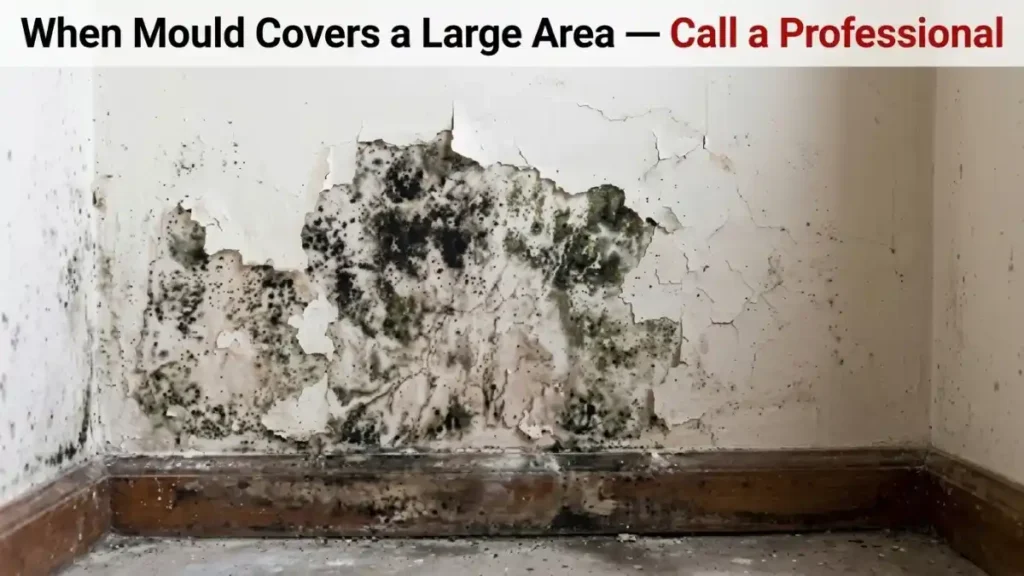
If mould has spread from one spot across the whole wall or ceiling never try to deal with it yourself. There are three situations where you should call in a professional.
The 1 Square Metre Rule (UK Safety Standard): According to NHS and Environmental Health guidance if the mould is smaller than 1 square metre (1 metre by 1 metre) a renter can clean it themselves. If the area is bigger than that DIY cleaning is dangerous because it releases huge numbers of spores at once.
Followed a Flood or a Burst Pipe: If the mould is the result of a big incident like a flood in the house at some point, or a pipe suddenly bursting the mould caused by this is usually much heavier and deeper and won’t be sorted out with a small spray or vinegar.
Asthma or a Weak Chest: If anyone in the house has asthma or breathing problems they should never clean it themselves because spores spread into the air during the cleaning process (as we discussed earlier) and this can be dangerous for them.
Who’s Legally Responsible: You or Your Landlord?
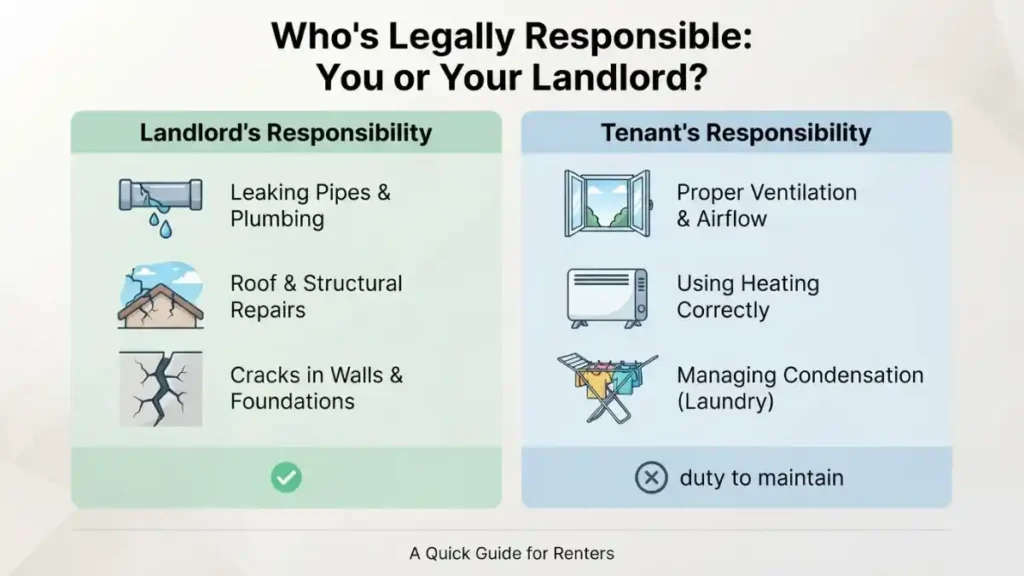
Under UK tenancy law who’s responsible for mould depends on what’s actually causing it. If it’s a property issue that’s the landlord’s legal duty but if it’s come from everyday condensation or a lack of ventilation looking after that is the renter’s responsibility.
Landlord or Tenant Who’s Responsible for Mould?
The landlord’s responsibility:
If the mould is caused by a leaking ceiling, a leaking pipe, rising damp, or poor insulation or ventilation in the building this is the landlord’s responsibility because under Section 11 of the Landlord and Tenant Act 1985 in the UK the landlord has a legal duty to keep the property’s “structure and exterior” (the building’s structure and outer parts) in good repair which includes walls, gutters, pipes, and heating and water installations. This law confirms that if the mould is from rising damp or penetrating damp it’s directly the landlord’s responsibility.
The tenant’s responsibility (lifestyle and maintenance):
If the mould has built up from condensation caused by a lack of ventilation in the rooms (not opening windows) drying clothes indoors, or low heating, looking after that is the tenant’s responsibility. In an official UK court case (Grand v Gill), the judge ruled that even if condensation is caused by an inherent design fault in the property (such as the building’s layout never being right from the start) the landlord can still be held responsible but if the renter didn’t use adequate ventilation or heating some of the responsibility will fall on them too.
My Landlord Isn’t Fixing It What Are My Next Steps?
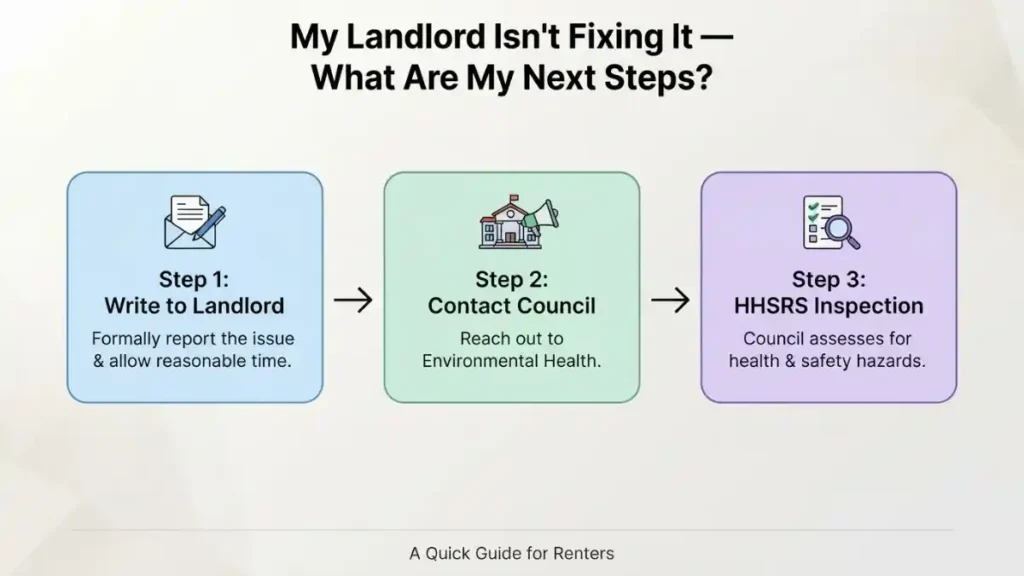
If your landlord still isn’t taking action despite a written report you have these strong legal options under UK law.
Wait for a “Reasonable Time”: Under UK law (the Landlord and Tenant Act 1985) the landlord is given a “reasonable time” to fix the issue. If the issue isn’t sever 14 to 28 days is usually considered reasonable, but if the mould is severe, action should be taken immediately.
Contact Your Local Council’s Environmental Health Team: If your landlord is ignoring your emails file a complaint with your local council’s Environmental Health team. A council officer will inspect the property under the HHSRS (Housing Act 2004).
Homes (Fitness for Human Habitation) Act 2018: Under this law if the mould has made the home unfit to live in and is damaging your health, you can file a case against the landlord directly in the County Court alongside the council process and claim compensation and if the mould is found to be a Category 1 Hazard during the inspection the council will issue the landlord a legal Improvement Notice.
How to Document and Report Mould to Your Landlord
Once you understand the cause of your mould and it’s time to tell your landlord simply saying it isn’t enough you need proof. Instead of just talking about it you should have written and recorded proof so your deposit and legal rights stay safe and so you have proof if the problem isn’t resolved later.
How to Take Photos That Actually Prove the Problem

Keep your phone’s date and time stamp turned on so it’s clear when the photo was taken. Take a wide shot of the whole wall so it’s clear how much the mould has spread and take a close up photo of the mould patch so its texture is visible too. If possible, place a coin or ruler next to it to show the size this comes in useful later. And if the mould is caused by a leak, a pipe, or window condensation, take a photo of that too.
How to Word an Email to Your Landlord About Mould

When writing an email to your landlord keep the tone professional and firm. Make sure the email explains these key points.
Clearly say where the mould is and how much space it covers. Make sure to mention that you’ve been properly ventilating and heating the room so they can’t blame it on your lifestyle. And if anyone in the flat has asthma or an allergy issue mention that too so they can sort it out as quickly as possible and give them a reasonable time to carry out the repair.
Subject: Urgent: Black Mould Issue in Bedroom, [Your Flat/House Number]
Hi [Landlord / Agency Name],
I am writing to report a black mould issue on the bedroom wall [e.g., near the window / behind the wardrobe].
I first noticed it on [Date], and I have attached clear photos showing the current condition. I consistently keep the room ventilated and heated, but the mould continues to return, which indicates an underlying damp issue.
As this poses a potential health risk, please confirm when an inspection or treatment can be arranged within the next 14 days.
Kind regards
[Your Name]
[Your Mobile Number]
Is Mould Dangerous to Your Health?
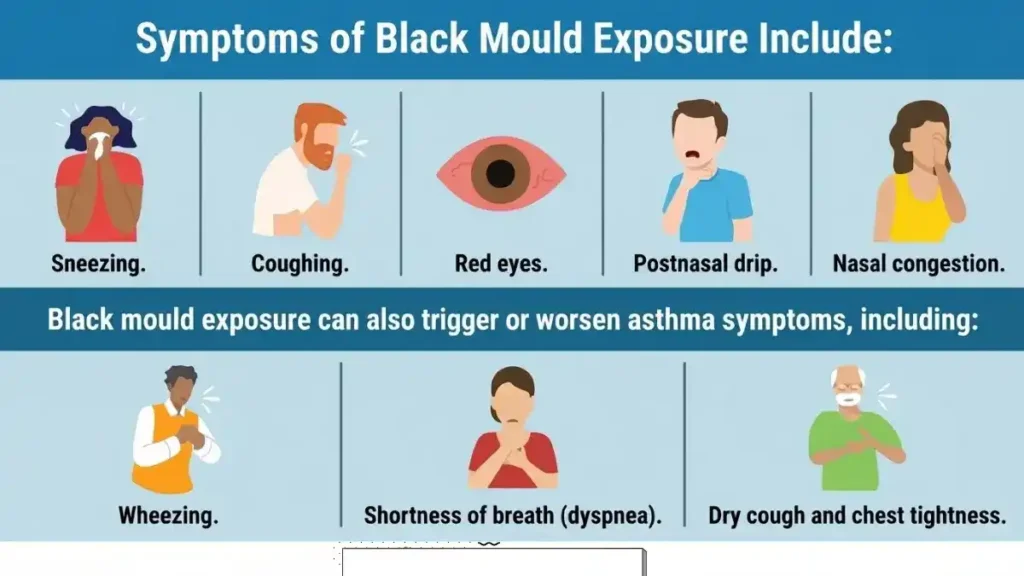
Black mould doesn’t just damage your walls it’s also a serious risk to your health especially when its microscopic spores float into the air and get breathed into your body. According to the NHS having damp and mould in the home increases the chances of respiratory problems, respiratory infections, allergies, or asthma. The UK Health Security Agency (UKHSA) and the NHS say that touching or breathing it in can cause allergic reactions such as sneezing, a runny nose, red eyes, or skin rashes. Mould can also trigger severe asthma attacks which is also backed up by detailed research from the World Health Organization (WHO).
The NHS clearly states that these people are affected by mould the most, and should stay away from damp or mouldy areas.
- Children and babies
- Older people
- People who already have skin problems (like eczema)
- People with respiratory problems (like allergies or asthma)
- People with a weakened immune system (such as those undergoing chemotherapy)
If anyone in your home falls into these groups treat mould as a priority straight away and don’t delay. If anyone is already showing symptoms (a cough, difficulty breathing), see your GP (General Practitioner) as soon as possible.
Your Legal Rights in 2026: What Awaab’s Law Means for Renters

Awaab’s Law has put a strong legal tool into renters’ hands. If your landlord is ignoring mould and damp you can send them a written complaint referencing this law after which taking action is no longer optional for the landlord it becomes a legal duty.
This law came from a tragedy A two year old child living in the UK named Awaab Ishak died in 2020 because of severe black mould on the walls of his flat. His parents had told the landlord about it but at the time the landlord blamed them instead. When the official investigating coroner looked into the case the report clearly confirmed that Awaab’s death was caused by mould spores getting into his body through his lungs and causing a lung infection.
After this event the UK government created Awaab’s Law so this wouldn’t happen to any other child or renter. This law was first applied to social housing but the UK government is now widening its scope so that Awaab’s Law’s strict safety standards and deadlines also apply fully to the private rented sector (private landlords and letting agencies).
Mould Prevention Checklist for Winter
Save this short checklist. Keeping an eye on these things daily through winter is usually enough to avoid mould.
- Open windows for 10 to 15 minutes daily, even in winter.
- Keep furniture 2 to 3 inches (5 to 10cm) away from external walls.
- Always keep a lid on pans while cooking.
- Keep the extractor fan running during and after a shower.
- Dry clothes near an open window, or with a dehumidifier.
- Check humidity with a hygrometer (keep it below 65%).
| Cause | Warning Sign | Quick Fix |
| Condensation | Wet windows every morning | Ventilation + dehumidifier |
| Penetrating damp | Mould near ceiling / one corner | Report to landlord structural issue |
| Poor insulation | Cold wall mould in one spot | Landlord must investigate |
| Overcrowded wardrobe | Mould on stored clothes | Leave gaps use moisture absorbers |
Frequently Asked Questions (FAQ)
Who is legally responsible for mould Landlord or Tenant?
Under Section 11 the landlord is responsible for structural issues (such as pipe leaks, roof failure, damp walls, and broken extractor fans). The tenant is only responsible for controlling internal moisture and lifestyle habits (such as ventilation and drying laundry indoors).
Can I refuse to pay rent if there is black mould in my flat?
No withholding rent isn’t legally allowed under UK law as it can put you at risk of eviction (a Section 8 notice). Instead send a written notice or contact your local council’s Environmental Health team.
Can a landlord charge or deduct my deposit for mould in the UK?
A landlord can only deduct from your deposit if they can prove to the DPS that the mould was caused by your carelessness. If the problem is caused by a structural leak or poor ventilation your deposit stays fully protected.
How long does a landlord have to fix mould under UK law?
After receiving a written report the landlord needs to start inspection and repairs within a reasonable timeframe. There’s currently no fixed number of days set out in law for private renters but strict fixed timelines under Awaab’s Law already apply to social housing (council/housing association properties).
What is Awaab’s Law and how does it protect UK renters?
This law places strict legal timelines on social housing landlords to take immediate action on damp and mould and in severe cases social landlords may even have to provide temporary alternative housing. This duty currently only applies to social housing. Its expansion to the private rental sector is expected but the exact timeline hasn’t been confirmed yet.
Mould in a UK rental bedroom, what should I do first?
First, take clear date stamped photos and wide angle shots of the mould. Then clean the area with white vinegar and immediately send your landlord a written or email complaint requesting an inspection.
Can mould in a bedroom make you sick or cause long term health issues?
Yes, definitely. Breathing in mould spores can cause allergic reactions, nasal congestion, asthma attacks, and lung infections. Ongoing exposure can be very dangerous for vulnerable people (like babies and the elderly).
What are the warning signs of mould toxicity or illness in the body?
Common symptoms include a persistent cough difficulty breathing, itchy or red eyes, frequent headaches, and skin rashes appearing.
How long can you safely live in a room with black mould?
There’s no “safe” length of time to live in a room with black mould. To avoid health risks it’s important to fix the issue and ventilate the room as soon as possible.
Does white vinegar or bleach kill mould on walls permanently?
White vinegar is effective at cleaning mould on the surface and slightly deeper layers while bleach only removes the surface stain. But if mould has gone deep into the drywall a permanent fix needs the moisture source dealt with and structural repairs carried out.
Does painting over mould kill it or stop it from coming back?
Painting directly over mould is completely wrong. Mould will grow back through the paint and cause the wall to bubble so the area needs to be treated with vinegar and dried out first.
What can you put on walls to stop fungus and mould from coming back?
After cleaning off the mould apply an anti mould or anti fungal primer and paint to the wall. This paint stops moisture and spores settling on the surface of the wall.
What kills mould naturally on drywall and ceilings?
Diluted distilled white vinegar or diluted tea tree oil (1 teaspoon of tea tree oil in 1 cup of water/vinegar) are the best natural options. (Note: tea tree oil is unsafe for pets/cats.)
How to stop mould and fungus in a bedroom in winter naturally?
Open windows daily for 10 to 15 minutes (cross ventilation), keep furniture 2 to 3 inches away from external walls, and keep indoor humidity below 65 percent.
How to safely remove fungus and mould from bedroom walls?
Arrange for your safety by wearing an N95 mask, safety goggles, and gloves. Spray with white vinegar, clean with a damp cloth after 1 hour and let the surface dry out completely.
Conclusion
Damp and mould problems in a UK rental home can usually be sorted out with the right legal knowledge and a few practical steps. Managing ventilation and everyday moisture is the tenant’s responsibility while fixing pipe leaks, poor insulation, and other building defects falls under the landlord’s legal duty, under Section 11 of the Landlord and Tenant Act 1985. Knowing which one applies to your situation is what protects both your deposit and your health.
The moment you spot mould, don’t panic. Take photos straight away, clean the surface with white vinegar, and send your landlord a written complaint. Never withhold rent as a way to force action, and if the problem still isn’t resolved, contact your local council. With the right timing and proof in hand, you can keep both your deposit and your health protected.
Author Bio
Written by Faizan Ali
Faizan Ali runs GlowUpMyRoom a blog focused on practical deposit safe home and rental living tips for UK and US renters. He writes hands on guides based on real rental experiences covering everything from small space organisation to solving common issues like damp and mould.
Last updated: 20 September 2026
Sources:
GOV.UK, Landlord and Tenant Act 1985 Homes (Fitness for Human Habitation) Act 2018 Housing Act 2004, Awaab’s Law
NHS.uk Can damp and mould affect my health?
Shelter England, shelter.org.uk
Energy Saving Trust, energysavingtrust.org.uk
HSE (Health and Safety Executive), hse.gov.uk