
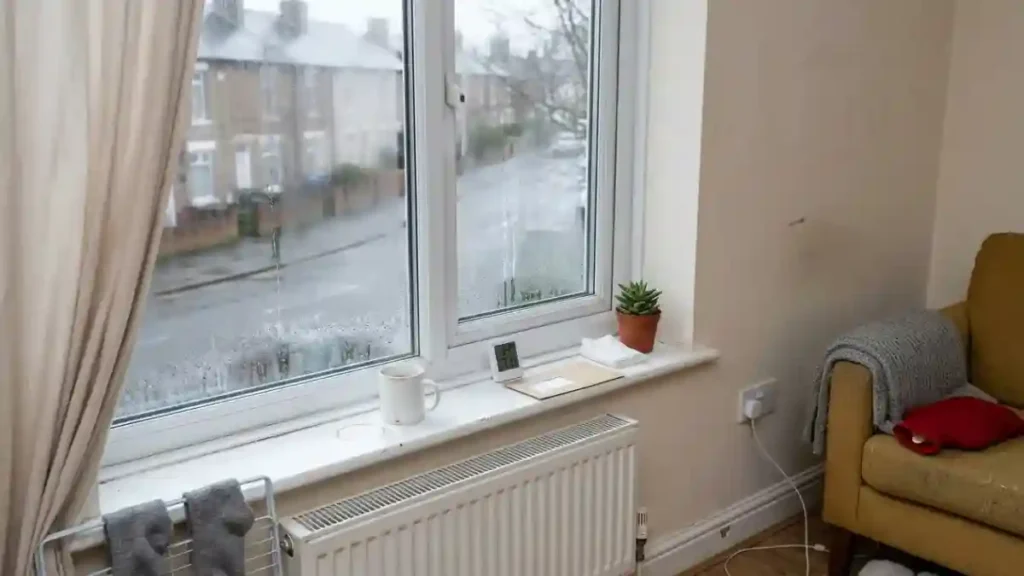
As soon as winter comes a very common problem starts in many rented flats in the UK: even when the radiator is on full you can still feel cold air in the room. Has this ever happened to you? You are sitting on the sofa and you feel a light cold breeze on your neck. Or you close the curtains at night but cold air still comes into your room from near the window.
This problem is very common in rented flats in the UK. The same thing happened to me the first time when I lived in a small flat in London. I was spending money on heating, but the warmth was leaving the room.
In a rented flat we cannot drill and we cannot change the windows. We are also scared about the deposit in case the landlord takes it. On top of this high energy bills spoil winter for renters. The biggest frustration is that the radiator is hot but our room does not get warm because of draughts.
But in this article I will tell you 9 fixes that I have tried myself. All of these fixes are without drilling so you will not need to drill anywhere. You will also learn when you should ask your landlord for permission and when your landlord must repair it.
Quick Answer: The fastest and legal way to stop draughts in a rented flat is to use non-damaging DIY fixes that do not need drilling. Fill the gaps around windows and doors with self-adhesive foam tape, secondary window glazing film, door excluder snakes and letterbox brush flaps. All of these fixes go on without drilling they are easy to remove when you move out and they keep the room warm without blocking the trickle vents. Also, if your front door is a fire door, ask your landlord before you make any changes.
Key Takeaways
- Draught vs Cold Surface: First check whether the cold air is coming in through gaps (a draught) or whether only the window glass is cold (a cold surface) so that you can use the right fix.
- Doors and Windows: First fix your doors and windows because most of the air comes in from here.
- Safety First: Do not block all the air Keep the trickle vents, airbricks and extractor fans open or there can be a risk of mould and CO.
- Fire Door Compliance: The front door of a flat is often a fire door so do not touch its seal its closer or its letterbox.
- Move-Out Plan: When you leave the flat take off all the temporary fixes carefully so that the paint does not get damaged.
9 Easy Ways to Stop Draughts in a Rented Flat (at a Glance)
| Fix | Approx. cost | Landlord permission? | Best used for |
| Draught excluder (snake/brush) | £0–£12 | Snake: No. Brush: Ask if fire door | Gap under the door |
| Foam/brush door strips | £4–£12 | Ask if fire door | Door frame edges & top |
| Letterbox flap & keyhole cover | £2–£10 | Ask if fire door | Front door draughts |
| Window foam/rubber strips | £5–£10/win | Usually fine | Casement windows |
| Window insulation film | £8–£20 | Inform landlord | Single glazing / fixed glass |
| Thermal curtains / liners | £10–£100 | No | Cold window glass at night |
| Gaps: skirting & floorboards | £3–£8 | Yes for caulk (use rope caulk) | Small gaps in older flats |
| Chimney balloon / sheep | £15–£30 | Inform landlord | Unused open fireplaces |
| Rug with underlay | Varies | No | Cold wooden floorboards |
How to Find Where the Draughts Are Coming From
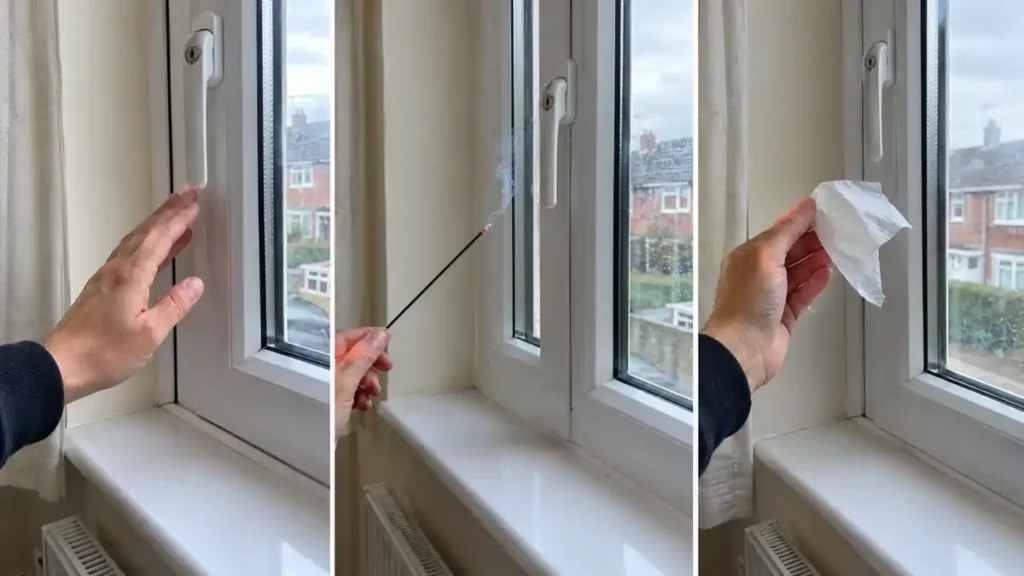
Before you fix any place, and before you buy tape or a seal it is very important to check where the air is coming from. This means you have to find the exact draught point. In UK rental flats the air comes from places where we do not even look and if we fix the wrong place we will waste both our money and our time. We can check this in 15 to 20 minutes and it is completely free. The best time is a windy day when the air is moving. Close all the windows and doors and check them one by one.
Check Around Windows and Window Frames
- Hand test: Wet your hand a little and run it along the edges of the window frame. On a windy day you will feel the cold air straight away on your wet skin.
- The Agarbatti (Incense Stick) Test: Take a burning incense stick near the window frame. If the smoke starts to move fast or runs to one side understand that there is an air leak there.
- Light test: Close the window of your room and shine a torch or phone light on the window from outside. If you can then see light coming in from the edges of the window there is a gap there.
- Shake test: Shake your window and door a little. If they rattle understand that air is passing through there too.
- Hinges and handle: The seal near the hinges and handle of an old window is often damaged and air can pass through there.
- Tissue test: Hold a piece of tissue paper near the edges of the window. If it moves there is a draught there too.
Check Doors, Letterboxes, Keyholes, Skirting and Pipe Gaps
- Gap under the door: At night turn on the hallway light and close your door. If light comes into your room from under the door air is coming in from there too.
- Letterbox and Keyhole: If the spring of your letterbox is loose or the keyhole is open cold air comes in straight from there and renters often forget this.
- Skirting board and floorboards: Where the floor meets the wall near the skirting boards put your hand there and check. Cold air also comes up through the floorboards.
- Pipes and cables: Also look under the sink behind the washing machine and anywhere a pipe or cable comes into the flat from outside.
How to Check Safely (and Not Confuse Cold Surfaces With Draughts)
Be careful with the candle or lighter test or it can burn the room or the flat. It is better for renters to use an incense stick or a tissue because an open flame can be dangerous near curtains.
If you smell gas do not light any flame. Open the window of that room and call the gas emergency number.
Also, keep your extractor fan off or the whole test will come out wrong. This is my practical tip and you must follow it.
Cold glass and a draught feel the same to us. But glass is very thin compared with a wall so it becomes very cold. The warm air of the room hits the glass becomes cold and heavy and starts to fall downwards. Because of this a stream of cold air starts to move across the floor and we feel it on our ankles. We think it is a draught and start looking for gaps in the skirting board and we cannot find any gaps. This is not air from outside it is the air of our own room.
How to tell the difference:
| Sign | Draught | Cold Glass (Cold Surface) |
| Tissue or incense smoke | Moves, flutters or gets pulled towards the gap | Usually flows straight down towards the floor |
| On a windy day | Felt much stronger | Wind makes little or no difference |
| Best Fix | Seal the gap | Thermal curtain or a sealed thermal blind |
Is It a Draught or Condensation?
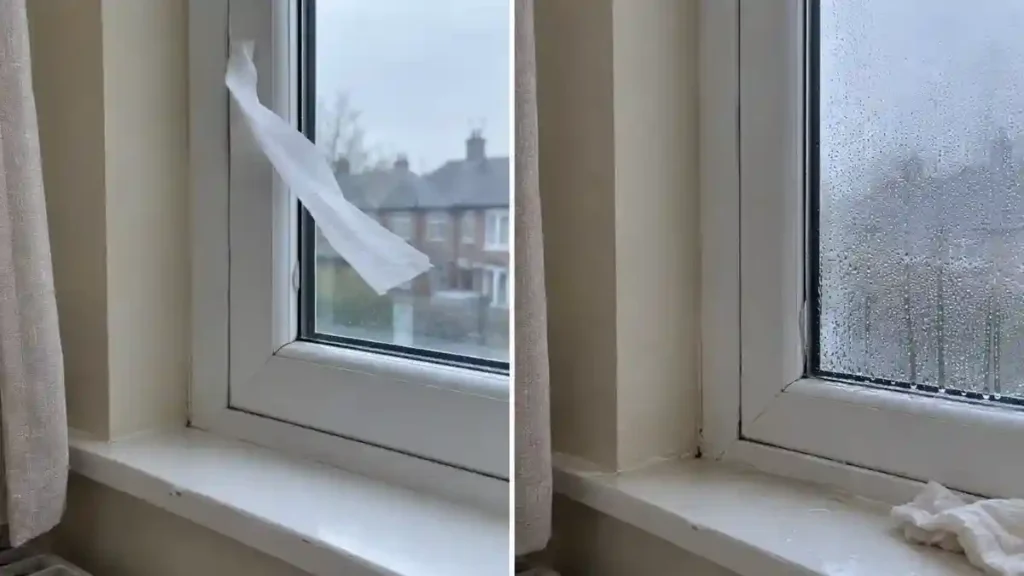
First of all we need to understand the difference between a draught and condensation:
- Draught: This is cold air coming in from outside which we feel on our ankles and neck.
- Condensation: This happens when the warm and humid air of the house (for example from cooking, bathing or breathing) hits a cold window or wall and turns into small drops of water.
We can understand this with the help of this table:
| Draught | Condensation |
| You feel moving air | Water drops on the window in the morning |
| Tissue paper or smoke moves | Black mould in window corners |
| Cold air hits a specific spot | Musty or damp smell in the room |
| Fix: Seal the gaps | Fix: Improve airflow and reduce moisture |
Important warning: Draught-proofing can increase condensation because the warm air of the house cannot go out. So while we draught-proof the flat we must not block the ventilation at all. If we do the draught will stop but condensation and mould will increase. UK councils give this advice.
- Do not draught-proof a room that has condensation or mould. If you want to first fix the dampness.
- Do not put draught-proofing on kitchen and bathroom windows.
- Do not draught-proof a room that has a fuel-burning heater (a gas fire).
- Do not block permanent vents and trickle vents.
Easy ways to reduce dampness:
- In the morning open the bedroom window for 5 to 10 minutes.
- Keep furniture a little away from the cold outside wall.
- When water collects on the window, wipe it off as soon as you get up in the morning.
You can also use a dehumidifier which will protect your room from condensation but it will also use electricity.
If mould has already started appearing on your walls, our full guide on how to stop mould in a UK rental bedroom → covers exactly how to deal with it and who’s responsible for fixing it.
Do You Need Your Landlord’s Permission to Draught-Proof a Rented Flat?
If you are using non-permanent temporary and non-damaging (zero drilling) fixes such as removable foam tape stick-on door sweeps or fabric excluders, then in 99% of cases there is no need to ask your landlord for permission.
If you use a screw or drilling in anything, paint the frame, or make any change to the landlord’s original property then written permission is a must. We understand permission in 3 colours:
| Colour | Meaning | Examples |
| Green (Usually fine to do) | Zero damage free-standing, or hung on existing fittings | Door snake, rug, thermal curtains on existing poles, bubble wrap (fitted with water spray) |
| Amber (Better to inform in writing) | Removable but involves stick-on tape or temporary fitting | Stick-on foam or brush strips, window film (double-sided tape) chimney balloon, letterbox brush, radiator foil |
| Red (Must get written permission first) | Permanent changes or alters building property | Screws, drilling, caulk/sealant, expanding foam, replacing seals, changing locks, letterbox edits or changes to a fire door |
Legally permission does not have to be in writing but written permission protects you and keeps your deposit safe. In one deposit scheme case a renter did work without permission and the adjudicator decided that a big part of the deposit should go to the landlord. According to UK law (the Landlord and Tenant Act) the responsibility for the structure of the building major gaps and permanent maintenance belongs to the landlord. If the draught is very bad the landlord should fix it.
Check Your Tenancy Agreement First
Before you put anything in your flat read your tenancy agreement and search for these words:
- Before you make any change to the flat search for these words: “Alterations” or “Improvements”
- Before you fix or decorate anything on a wall or door search for these: “Decoration” or “fixtures and fittings”
- Before you use sticky tape or glue, nails or screws search for: “Adhesive”, “nails”, “screws”
- For fire-protection doors or a chimney search for: “Fire door”, “chimney” or “fireplace”
- Look for the “Alterations Clause”: In a tenancy agreement there is a specific section that says what a renter can change in the flat and what they cannot.
- Understand “Fair Wear and Tear”: When the tenancy ends you have to give the flat back in the same condition as you found it. So use reversible fixes so that when you leave the flat they can be removed easily.
- When to Email Your Landlord/Agent: If you have any doubt even about a temporary fix you can send a polite email to the landlord or the letting agency and get written approval. With this proof your deposit will also be safe.
How to Stop Draughts Under and Around Doors
First fix the door because the biggest reason for cold and air coming into a flat is the door. There are often big gaps under the door and at its edges and air comes in through them. In this section we will look at 3 ways that I have tried myself and they have been very useful.
Fix 1: Fit a Draught Excluder Under the Door
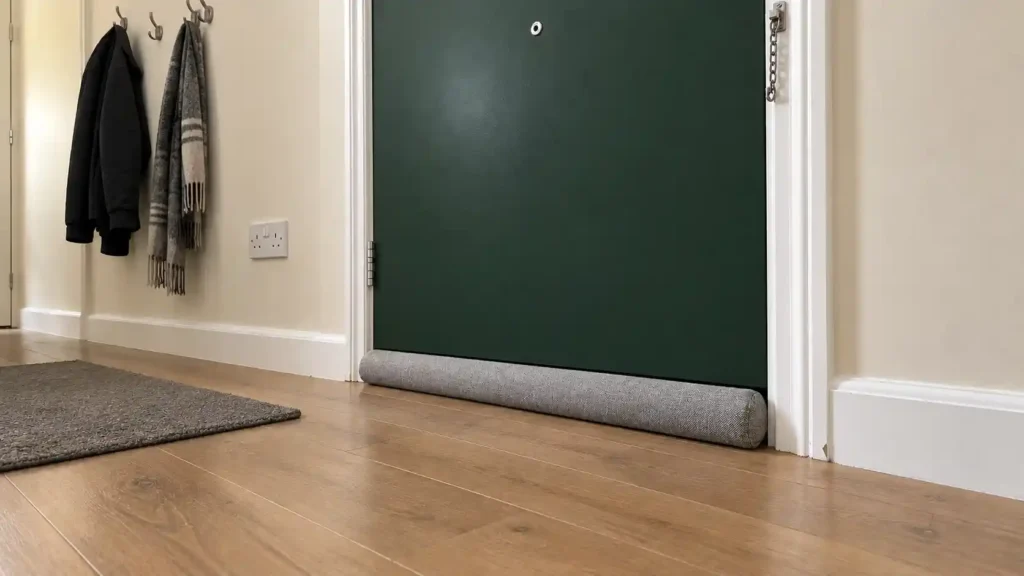
There are a few ways to close the gaps under a door. Let us understand them one by one:
- Fabric “snake”: This can be very useful for renters. You can make it yourself. I have tried it myself too and I found it very good. It stands on its own so there is no need for a drill or for sticking anything. To make it, take a long fabric tube (such as old tights, a sock or the bottom part of an old pair of trousers) and fill it with rice, lentils, sand or old clothes. Then close it by sewing it or tying a knot. Close the door and put it on the inside at the bottom. A ready-made snake from a shop costs £5 to £15.
- Door Sweep or Brush Strip: If you want to put on a brush or a sweep first order it online or buy it from a shop. Then cut it to the width of your door, take off the paper on the back and stick it on the back of the door. Before you stick it check that the brush just touches the floor but that there is no resistance when you pull the door.
Note: If the floor is laminate or wood the brush can scratch it. Sticking a strip on the door can spoil the paint of the door so first test it on a small area.
Fix 2: Seal Door Edges With Compatible Foam or Brush Strips
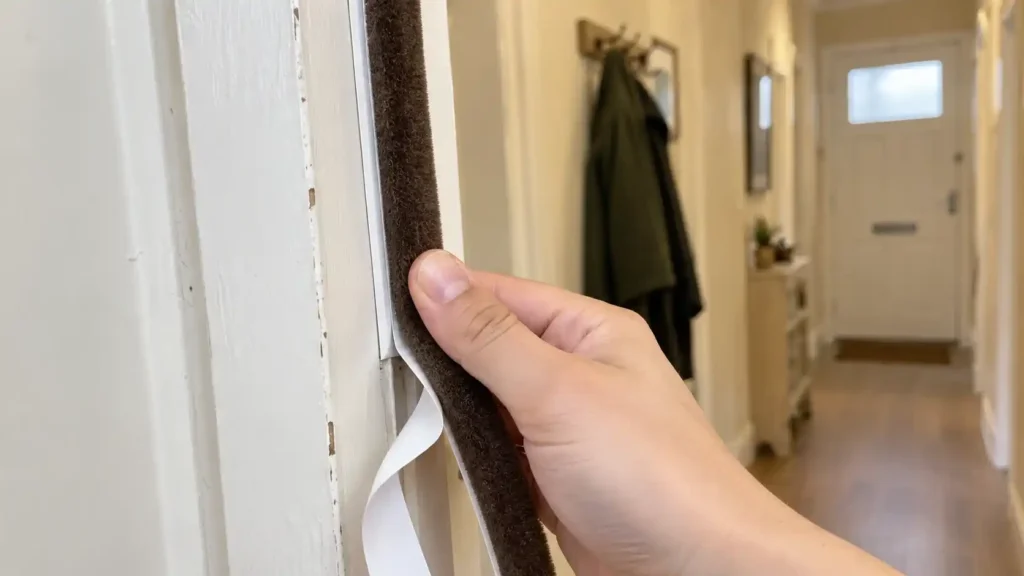
We have closed the gap at the bottom of the door. Now we have to seal the 3 sides of the door (the top and the 2 sides). For this we will need an adhesive V-profile strip. Check the strip before you buy it. If it is too thick, the door will not close and if it is too thin the gap will not close. So check it before you buy it.
How to put it on: Before you use it clean the place where you are putting it well and let it dry. If needed wipe it with white spirit and cut the strip to fit your frame. Take off the paper on the back little by little and stick the strip on as you go. Do not pull it or it will become weak. Put it on the door frame not on the door itself so that it is pressed properly when the door closes.
Close the door and check that the latch has caught properly. If the door does not close move the strip back a little or cut it in half. On an old door, stick-on foam gets squashed and tears very quickly. This is my own experience. If your door frame is old you can check it too.
Fix 3: Cover the Letterbox and Keyhole
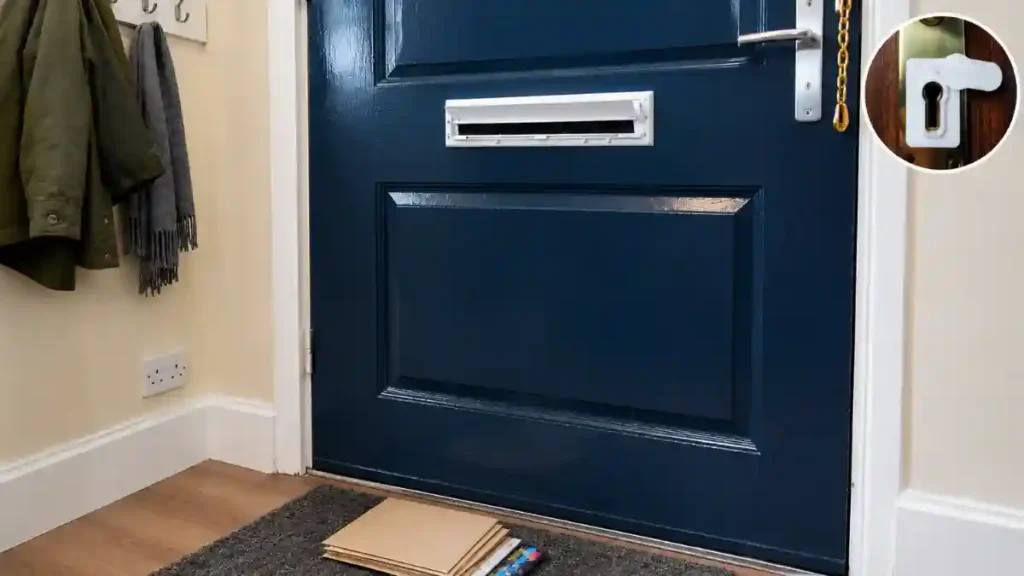
A letterbox and a keyhole are small holes in the door and cold air from outside comes straight in through them. I think most renters forget this.
- Keyhole Cover: To fix this we will use a swinging cover. It is a very small tool that goes over the keyhole and moves away when you put the key in. You can put it on in 30 seconds and it costs up to £2. It comes in two types: one that sticks on and one that uses screws. For renters, the one that sticks on is the best.
- Letterbox brush or flap: To fix this we will use a letterbox flap. It goes on easily on the inside or the outside in about 5 minutes. It keeps the air out but the post can still pass through it. This also comes in 2 types and for renters the one that sticks on is best here too.
Warning: If the front door is a fire door ask your landlord before you put anything in the letterbox.
Flat Front Door? Check It Is Not a Fire Door First
The front doors of UK flats are not ordinary doors. They are fire doors so it is very important to check this. Before that understand what a fire door is: it is a special door that can stop fire and smoke for at least 30 minutes. Here a question comes up: which door is a fire door? In a building where there is a common corridor or stairs the front door of the flat is often a 30-minute fire door. It is not fitted in every flat so ask your landlord first.
How to recognise it:
- A self-closing device (a closer) is fitted at the top of the door.
- There are small strips or brushes at the edges of the door and the frame (intumescent strips and smoke seals).
- The door is thicker than normal (usually 45 mm).
- There is a special fire-resistant lining inside the letterbox.
What not to do:
- Do not put anything on the intumescent strips or smoke seals and do not paint over them.
- Never remove the closer of a fire door and do not change it.
- UK council guides clearly say: do not fit your own lock letterbox spyhole or vents.
- Do not put anything on the door that stops it from closing fully. The most important job of a door is to close.
When a Faulty Door Needs Landlord Attention
Some problems cannot be solved by DIY and we have to report them to the landlord:
- Even when the door is closed light or strong air comes in through big gaps.
- The door does not close properly or its latch does not catch.
- The seal of the door is broken or it has been squashed flat and stuck.
- Your door has been fitted in the wrong way.
- Your door has become completely warped (twisted).
According to the UK Landlord and Tenant Act 1985 (Section 11) the main entrance door of a flat and its frame are part of the structure and exterior of the building and it is legally the landlord’s responsibility to repair or replace it.
How to Stop Draughts From Windows Without Drilling
After doors windows are the second place where most of the cold air and draughts come into the house. In this section we will look at 3 easy zero-drilling ways by which we can fully insulate our windows without any damage.
Fix 4: Add Suitable Strips Around Opening Windows
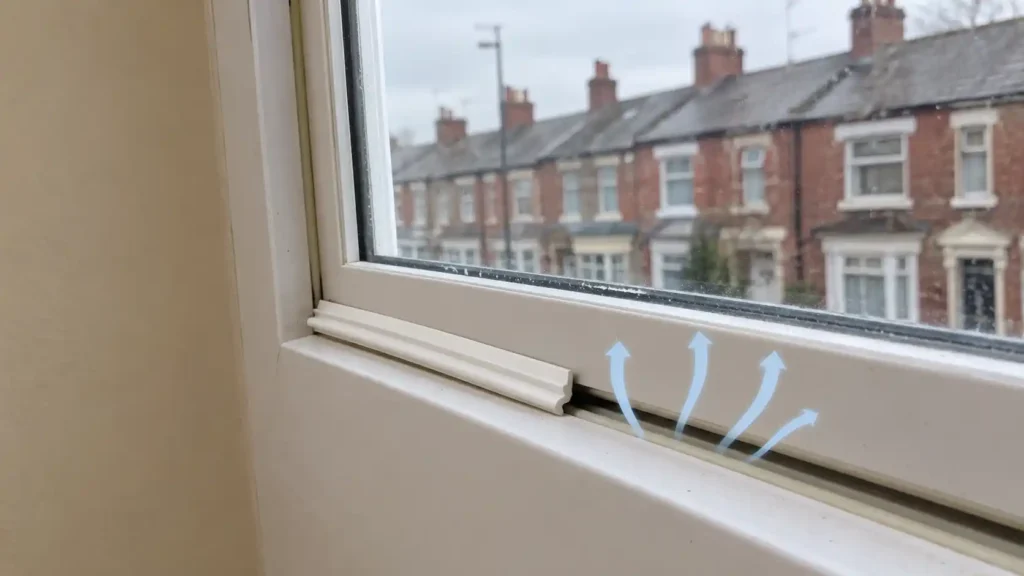
Air also comes into the room through the edges of windows. To stop it we will put weatherstripping on the edges where the window opens and closes. There are many kinds but for renters the best are self-adhesive foam tape or V-profile rubber seals. Choose one to fit your gaps.
How to put it on:
- First clean the frame well. If needed wipe it with white spirit.
- Cut the strip to fit your window.
- Put the strip on the part of the frame where the window presses when it closes not on the part of the window that opens.
- Then put the strip on the frame and check that the window latches or locks easily.
- For an old sash window a brush strip (pile weatherstrip) works better.
Important: Do not put the strip on trickle vents and drain slots. They are made for air. Also do not put draught-proofing on kitchen and bathroom windows.
Fix 5: Use Temporary Window Insulation Film
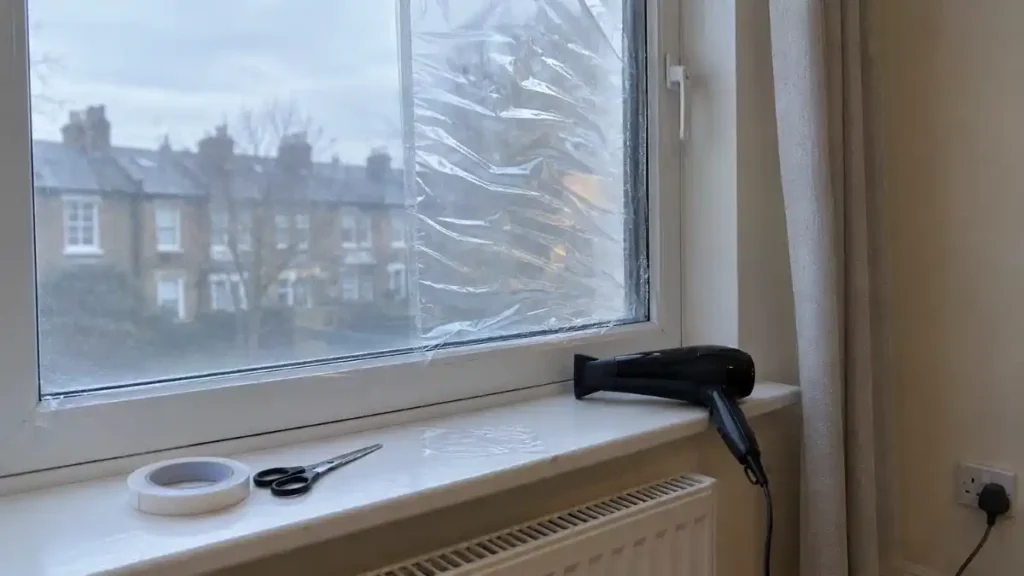
If your flat has single-glazed windows and cold air comes in from there and you want to stop it you can use window insulation film. It is very cheap and works like secondary glazing. It is a renter-friendly solution.
What it is and how it works:
- It is a very thin clear plastic sheet that is put on the inside frame of the window with double-sided tape.
- Air gets trapped between the glass and this film. This makes an insulated air gap, exactly like double glazing, and it stops the cold from outside from coming in.
Step-by-step way to put it on:
- Cleaning: First clean the window frame well and let it dry so that the tape sticks properly.
- Measurement: Measure your window frame on every side and cut 10cm extra so that adjusting later is easy.
- Taping: Put the double-sided tape that comes with the kit on all four edges of the frame.
- Applying Film: Starting from the top stick the film down to the bottom carefully so that no wrinkles form.
- Shrinking: Use the heat of a hairdryer to shrink the film so that it becomes completely smooth and tight.
- Trimming: Cut off any extra film with a cutter and clean it up.
Weaknesses: On whichever window you put it you will not be able to open that window. So do not put the film on a window that you use for ventilation or condensation will increase.
Paint damage risk: When you take off double-sided tape, the paint can come off. So before you put it on test it on a small area first.
Fix 6: Hang Thermal Curtains or a Door Curtain
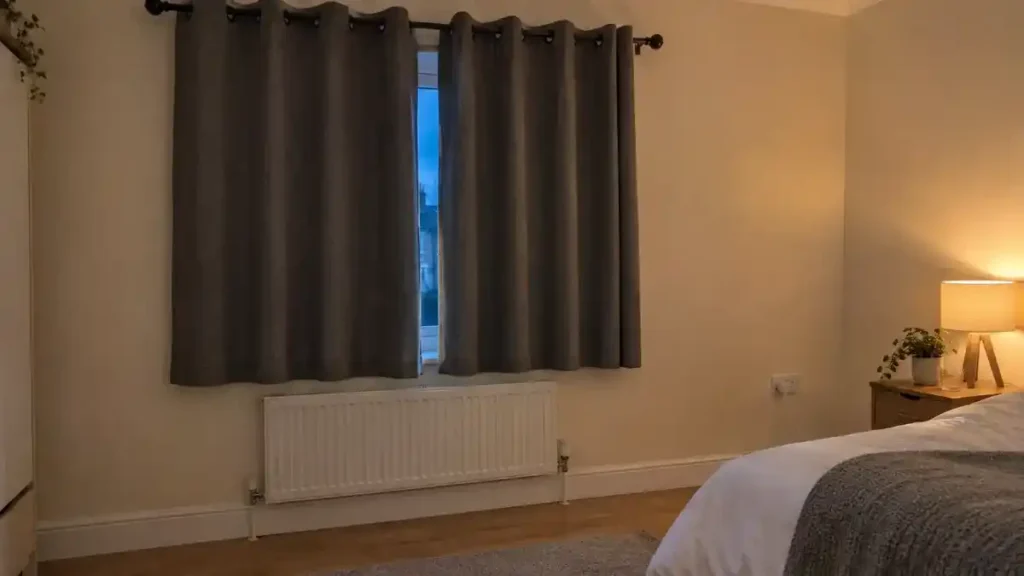
To stop cold air coming into the room you can use thick curtains or thermal lining. They stop the cold air coming from the glass at night from spreading into the room. And the most important thing: just hanging a curtain is not enough you also have to seal it. If there is a gap between the edges of the curtain and the wall cold air can go around from there and come into the room.
So the curtain should be wider than the window and it should reach the floor or the window sill. You can use holdbacks or magnets to keep the curtain close to the wall. You can follow a routine that I use myself: close the curtains as soon as it gets dark and open them as soon as it is morning so that the room gets warm by itself from the heat of the sun.
Which curtain or option is best?
- Thermal liner: This goes on the back of your old curtain. You can put it on with rings or by sewing.
- Charity shops: At the end of winter people donate thermal curtains and you will get them cheap there.
- Honeycomb blind: These fit close to the window frame and can reduce heat loss by about 40%.
- Door curtain: To hang a thick curtain on the front door use a tension rod or an existing rail (no drilling). If it is a fire door make sure the curtain does not stop the door from closing.
Which Fix Works for Which Window Type?
| Window Type | Best No-Drilling Fix | Important Note |
| Casement (Hinged, opens outwards/inwards) | Stick-on foam or rubber strip on the frame | Fit the strip on the frame rebate so the handle can close properly |
| uPVC | Stick-on strip on clean uPVC. If the gasket is damaged ask your landlord | Never block trickle vents or drain slots |
| Sash (Slides up and down, traditional wooden) | Thin brush or pile strip along the sides foam strip at the bottom | Avoid thick foam in sliding tracks, as it can jam the window |
| Fixed (Non-opening window) | Window insulation film or bubble wrap | Be careful in kitchens and bathrooms due to moisture |
| Single glazing (Single pane of glass) | Insulation film thermal blinds or lined curtains | Makes the biggest difference to warmth and energy bills |
| Double glazing | Check window seals use thermal lined curtains | Smaller temperature difference, as double glazing is already insulated |
When a Draughty Window Needs Repair, Not a DIY Fix
- Broken latch: If the window handle or lock is broken and the window will not shut properly.
- Broken hinge or arm: If the mechanism used to open and close the window is broken.
- Misty double glazing: If water drops or fog are trapped between the two window panes (this means the seal is broken).
- Leaking rainwater: If rain water drips inside your flat through the window edges.
- Rotted frame or cracks: If the wooden frame is damaged do not try to fix it yourself with tape report it to your landlord instead.
Gaps, Fireplaces and Cold Floors
Besides doors and windows, there are some hidden places in the house that renters do not know much about and cold air comes in from them too (such as the floorboards, the edges of the walls, and an old fireplace). Now we will look at 3 easy ways to seal them.
Fix 7: Deal With Small Gaps Around Skirting, Floorboards and Pipes
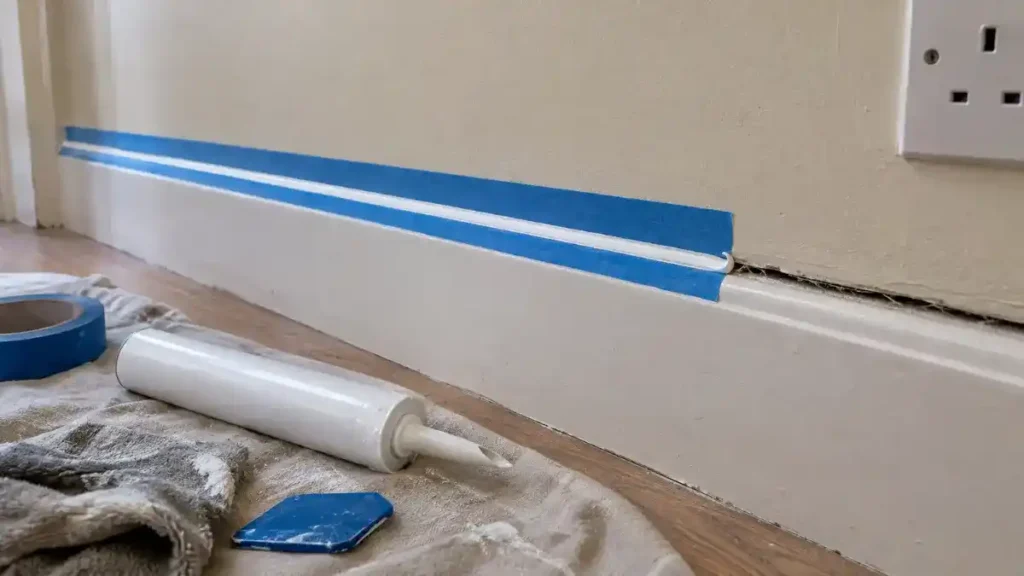
Over time gaps form in a wooden floor (floorboards) and in the strip that runs along the wall (skirting boards). There are also small holes around pipes and cold air comes in through them.
If the gaps are very small you can use removable caulk (one that matches the floor) or foam or sealant which can be cleaned off easily when you move out. Before you put it on, you can tell your landlord. If the gaps are big talk to your landlord and do not put anything on them yourself.
Where a pipe or cable comes in from outside there is a gap there too. To close these you can use a draught-proofing seal ring or flexible putty which does not damage the wall or the pipe. It is a must to close these or they can become a way in for mice and insects.
Fix 8: Use an Excluder Only for a Genuinely Unused Fireplace
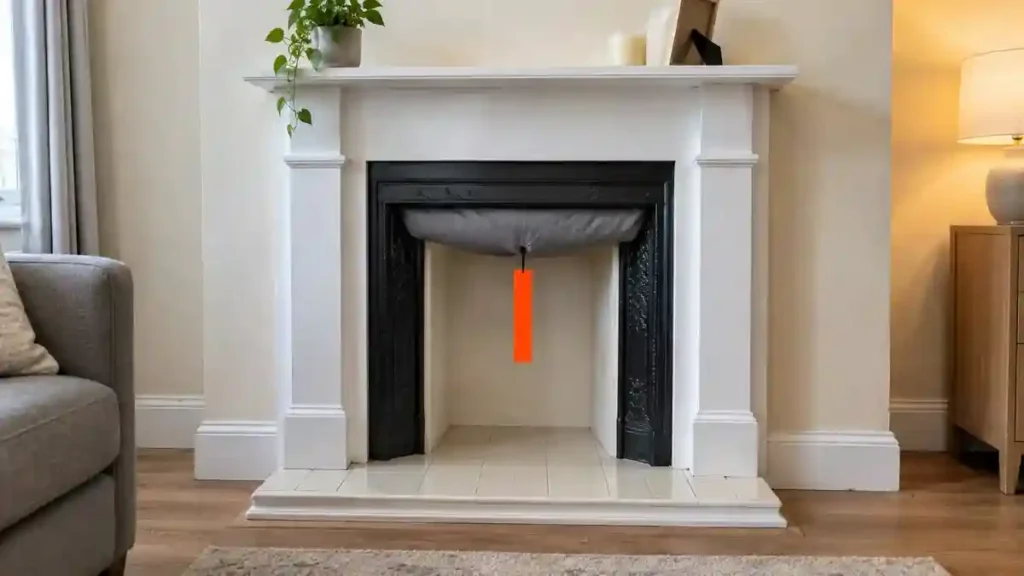
In old flats that have an open fireplace (such as a chimney) warm air goes up and cold air comes down from there. Before you fix this, confirm that it is completely unused.
To fix this we will use a chimney sheep or an inflatable chimney balloon. It is a foam or rubber balloon that goes inside the chimney, swells up and stops the cold air. It does not need any permanent drilling, and when you leave the flat you can take it out easily.
If you want to light a fire in the chimney take out the balloon. Also stuffing clothes into the chimney is wrong. If you forget and light a fire it can be dangerous. If there is a gas fire or a gas appliance do not block the way at all, because they need air and the smoke goes out through the flue.
Fix 9: Add a Rug and Suitable Underlay Over Cold Floorboards
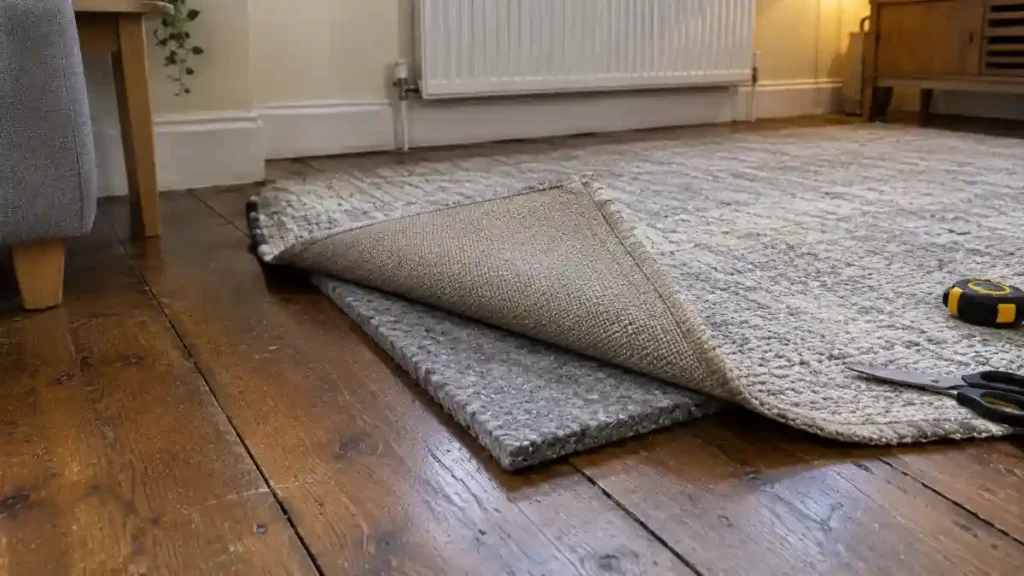
In old UK houses the floor is wooden and very cold. To stop this, you can lay a rug on it.
First of all fix the gaps in the floor or air can come up from under the rug. Then choose a rug to fit the size of the floor (a small rug will not solve the problem). Before you lay the rug put rug underlay under it. This underlay stops the cold from below from coming up (especially where there is a basement it must be used there). Choose a non-slip underlay, so that you do not fall when the rug slips.
If the floor is wet or damp fix that first or mould can form there if you lay a rug. A rug and underlay are a very good option for renters to stop the cold of the floor.
Which Draught-Proofing Fix Is Best for Your Rental?
You do not need to do all the fixes at the same time. First find your problem and then fix it. Follow this table to fix your problem.
| Your Problem | First Fix |
| Cold air under the door, cold ankles | Fix 1: Draught excluder (door snake) |
| Light or air coming around door edges | Fix 2: Door strips (and inform your landlord) |
| Direct cold air through the front door | Fix 3: Letterbox brush and keyhole cover |
| Window rattles or lets cold air in | Fix 4: Window weatherstrips |
| Window glass feels very cold at night | Fix 6: Lined curtains or thermal blind, and Fix 5: Window film |
| Floor feels very cold | Fix 9: Rug with underlay, and Fix 7: Fill floor gaps |
| Cold air coming from an unused fireplace | Fix 8: Chimney balloon / chimney sheep |
You should follow this routine: first doors and windows then the loft hatch then the floor then the chimney and the gaps around pipes and in the end use thermal curtains. And this is the best for renters.
You can follow this plan according to your own situation.
| Plan | What is included | Approx. cost |
| £10 plan | Homemade door snake (old tights and rice), letterbox brush, keyhole cover, and a small foam strip for the door | Around £10 |
| £30 plan | Everything in the £10 plan, plus foam or rubber strips for 2 windows and 1 window insulation film kit | Around £30 |
| £60 plan | Everything in the £10 plan, plus window strips for 2 windows, thermal liners for 2 curtains, and rope caulk | Around £60 |
Ventilation and Safety: What You Must Not Block
First of all we should understand that draught-proofing means controlling the air not blocking the air. A house needs a little fresh air. If we do not give it fresh air, mould can form and appliances that use gas can become dangerous. We can understand this with a simple example: a draught is air that comes from the wrong place and ventilation is air that comes from a good place and by our own choice. We have to stop the draught not the ventilation.
Keep Airbricks, Trickle Vents and Extractor Fans Clear
Never block these things:
- Trickle vents: On new windows there is a small slot through which a little air comes in. Never block these.
- Airbricks and wall vents: Never block the holes with a grille in the wall either. They are there so that air can pass inside the house and underneath it.
- Extractor fan: This is often fitted in the kitchen and bathroom and it takes the dampness out.
- Underfloor grilles: These are for air under a wooden floor so do not block these either.
Gas Fires, Flueless Heaters and Carbon Monoxide Alarms
If you have a gas fire a gas heater or a boiler in your house then safety is needed there more than anywhere. If your flat has a gas fire or a flueless heater never block the way or the flue or vent around it. Gas needs air to burn. If the way for air is blocked Carbon Monoxide can form which can kill (it is a poisonous gas with no colour and no smell). So always check that the flat has a Carbon Monoxide Alarm fitted and that it is working properly.
According to the rule in England since 1 October 2022 the landlord must fit a CO alarm in every room where there is any fixed combustion appliance (such as a gas fire, a boiler, and so on). A gas cooker is not included in this.
If the alarm in your flat is faulty tell your landlord, and he will fix or replace it. If the alarm ever goes off first open the windows get out of the flat and call the gas emergency number 0800 111 999. Do not go back inside until the engineer says so. Also never run the oven or the gas stove to heat the flat because this carries a risk of carbon monoxide. Use an electric heater instead.
Avoid Increasing Condensation and Mould Risk
Often dampness can increase after draught-proofing so follow these steps:
- Where there is already condensation or mould fix the dampness before you draught-proof.
- Do not put strips on kitchen and bathroom windows.
- Wipe the water that collects on the window every day so that condensation does not form.
- A dry room is easy to heat and a damp room is a little harder to heat. So reducing dampness is also a way to save on heating.
Is a Draughty Window or Door the Landlord’s Responsibility?
Many renters think that every draught is their own responsibility but this is not so. According to UK law it is the landlord’s legal responsibility to keep the structure of the house the windows and the doors in good condition.
Which law?
- Landlord and Tenant Act 1985 (Section 11): The landlord has to keep the structure and the exterior of the property in repair. This law includes the walls, roof, windows and external doors and heating also comes under it.
- Homes Act 2018: According to this law, a house must be fit to live in. Very strong cold mould and damp-type hazards can make a house unfit.
- HHSRS: The council uses a system (the Housing Health and Safety Rating System). In this system “Excess Cold” is included as a hazard. The council’s Environmental Health Officer can inspect and can order the landlord to do the work.
How quickly should the landlord repair? There is no fixed number of days for this. In law there is a “reasonable time” for it. The more dangerous the problem the quicker it can be fixed.
How to Ask Your Landlord to Fix Draughts (Free Email Template)
Instead of telling your landlord by phone tell them by email. If you tell them by email you also have email proof which is very useful. Add these details in the email:
- Write your problem clearly: where since when and what you feel.
- Take photos and be sure to write the date.
- Tell the landlord by when you want a reply (for example, 14 days).
- Send the email and keep a copy. If you talk on the phone confirm it later in writing by email.
Template
Subject: Draughty window at [address] – repair request

Dear [Landlord or agent name],

I am writing to report a draught at [address]. Since [date], cold air has been coming in around [the living room window / the front door]. On windy days I can feel it with my hand, and [light is visible around the frame / the seal looks damaged]. I have attached photos taken on [date].

The room is now difficult to keep warm, and I am worried about [rising heating costs / condensation].

Could you please arrange for the [window seal / door frame] to be inspected and repaired? Please let me know by [date] when a visit can take place. I am happy to give access.

In the meantime, I would like to fit removable draught-proofing strips that can be taken off without damage. Please let me know if that is fine.

Kind regards,
[Name]
[Phone number]
What If Your Landlord Does Not Respond?
If your landlord is not replying to your email or refuses to do the repair you can do this:
- Follow-up reminders: After 14 days send a reminder email. Refer to the first email and attach the photos again.
- Contact the council: If your flat is very cold and it is becoming a health problem for you contact the Environmental Health team of your local council. The council can inspect and send the landlord a legal notice.
- Citizens Advice: You can contact charities to get free advice.
Important: Also never start withholding rent because under UK law not paying rent can become the biggest excuse for eviction even if the landlord is not doing the repair.
Can You Be Evicted for Asking for Repairs?
Many times renters are afraid that if we ask the landlord for a repair the landlord will make an excuse and evict us. In England, since 1 May 2026, landlords can no longer use a Section 21 notice (no-fault eviction). The landlord now needs a valid legal ground, so asking for a repair or complaining to the council is not a reason to evict you. But if the landlord has a genuine ground (rent arrears, selling the house, living in it himself) he can still evict.
Need help? If you think you are being treated unfairly after you made a complaint, contact Shelter or Citizens Advice for free advice. These rules apply to England; Wales, Scotland and Northern Ireland have different rules.
Still Cold After Sealing? Keep the Room Warm More Efficiently
First of all understand that draught-proofing does not make warmth. It only keeps the warmth in. If there is no warmth coming into the room at all draught-proofing alone will not make much difference. In this section we will see how to make the heating of a room more efficient without a high electricity bill.
How Much Does a Portable Heater Cost to Run?
According to the Ofgem price cap from 1 October to 31 December 2026 the electricity unit rate is 26.32p per kWh. This rate is for a standard variable tariff. A fixed tariff can be different.
| Heater Type | Power | Cost per hour | Daily cost (4 hours) | Monthly cost (4 hours daily for 30 days) |
| Fan or convector heater | 2 kW | 52.6p | £2.11 | £63.17 |
| Oil-filled radiator | 1.5 kW | 39.5p | £1.58 | £47.38 |
| Panel heater | 1 kW | 26.3p | £1.05 | £31.58 |
| Infrared panel | 500 W | 13.2p | 53p | £15.79 |
Warm the Person and the Space Safely
Instead of warming the whole room first warm yourself. This is the cheapest and safest way.
- “Some people recommend”: Some renters say do not wear cotton straight on the skin because it soaks up sweat and stays wet. A merino wool or synthetic base layer is the best.
- Wool blanket: A wool blanket on the sofa is among the best things. It is very useful and you can get it cheap from a charity shop.
- Hot water bottle: Instead of running a heater to warm the whole room using a hot water bottle when you go to sleep is very cheap and effective. Just take care of one thing: do not pour in water that is boiling straight away. After the kettle boils, wait 5 minutes.
- Bed: Put a blanket on top of the mattress and under the sheet. It stops the cold coming from below first.
Moving Out: Remove Temporary Fixes Carefully
When you are about to leave the flat and end the tenancy follow these 5 ways to save your deposit:
- Make a list first: First of all make a list of what you have put in (such as strips, film, hooks, a balloon, caulk).
- Stick-on strips and tape: If you have put tape or anything similar on a window or anywhere else warm it a little with a hairdryer and pull it off slowly. Do not be in a hurry to take it off or the place where it was put can get damaged.
- Sticky marks: When you take tape off a window frame and a door a sticky glue is left there after you take it off. To take it off clean it with lukewarm water and dishwashing soap.
- Chimney balloon: If you put a balloon in the chimney let the air out of it take it out from there and take it with you.
- Fair wear and tear: The cost of things that wear out from normal use is not taken from your deposit. But the cost of your changes or damage is taken from your deposit. If money is taken from your deposit unfairly you can challenge it through the deposit scheme.
Your First-Weekend Checklist
Safety First (5 minutes)
- Test the Carbon Monoxide (CO) and smoke alarms.
- Check that the trickle vents, airbricks and extractor fans are open (never block them).
Saturday Morning (30 minutes)
- Look for draughts with a tissue or an incense stick on a windy day (windows, doors, letterbox, floor).
- Take a photo of every problem and note the date.
- Read the alteration clause in the tenancy agreement.
- Check whether the door is a normal door or a fire door.
- Email the landlord (with the permission and repair list).
Saturday Afternoon (1 hour)
- Make a door snake or put one at the bottom of the door (Fix 1).
- Put on a keyhole cover and a letterbox brush (Fix 3).
- Put on door strips, if it is removable tape (Fix 2).
Sunday (1 to 2 hours)
- Put on window strips (Fix 4) or insulation film (Fix 5).
- Put up curtains or liners and make a routine: close them as soon as it gets dark open them in the morning (Fix 6).
- Put a rug and underlay on the floor (Fix 9).
- Bleed the radiator and move furniture 6 to 12 inches away from the radiator.
- Set a reminder for next week to check for water (condensation) or mould behind the curtain or the film.
Frequently Asked Questions
Can I Draught-Proof a Rented Flat Without Drilling?
Yes, of course! Door snakes, stick-on foam, window film and thermal curtains go on without drilling. Just inform your landlord about the stick-on items and take permission from your landlord before you put anything on a fire door.
Is Draught-Proofing the Tenant’s or the Landlord’s Responsibility?
It is the responsibility of both. Repairing damaged window frames and broken seals is the landlord’s legal responsibility (Section 11, Landlord & Tenant Act 1985). But small temporary fixes (such as door snakes and removable tapes) a tenant can easily do himself.
Can Draught-Proofing Cause Condensation or Mould?
Yes, if the natural ventilation of the room is blocked. So never block the trickle vents, airbricks and extractor fans and let a little air come into the kitchen and bathroom so that there is no risk of dampness and mould.
How Much Can Draught-Proofing Save?
According to the Energy Saving Trust draught-proofing can save about £20 to £85+ a year (or £45-£60 in an ordinary flat). Its real benefit is that the room stays warm even on less heating, and you can turn the thermostat down a little.
How Much Does a 2kW Heater Cost to Run?
According to the UK price cap (26.32p per kWh), running a 2kW heater costs about 53p per hour (or ~£2.11 for 4 hours in a day). So stopping draughts is far cheaper and wiser than running a portable heater.
Can Window Insulation Film or Foam Strips Be Removed When Moving Out?
Yes, of course! At move-out, warm the tape with a hairdryer and take it off slowly and clean the leftover mark with isopropyl alcohol. After cleaning be sure to take photos so that there is no deposit problem.
Conclusion
The first rule of draught-proofing is that first you find the gaps and then you choose the right renter-safe fix. It is necessary to take permission from the landlord for permanent work or for any change to a fire door and never block the safety ventilation (vents and airbricks) of the room. If the window frames or seals are very damaged report it to the landlord in writing.
“You do not need to drill, spend a fortune, or fight your landlord to make a rented flat warmer—you just need to find the leak and choose a fix you can undo.”
About the Author
Written by Faizan Ali (GlowUpMyRoom.com)
Last updated: 22 November 2026
I help renters so that they can make their flat warm without drilling and without losing their deposit. This guide is based on the official data of the UK Government (gov.uk), the Landlord & Tenant Act 1985 (Section 11) and the Energy Saving Trust.
Note: Before making permanent changes or putting anything on a fire door, be sure to ask your landlord. The legal information in this guide applies to England.