
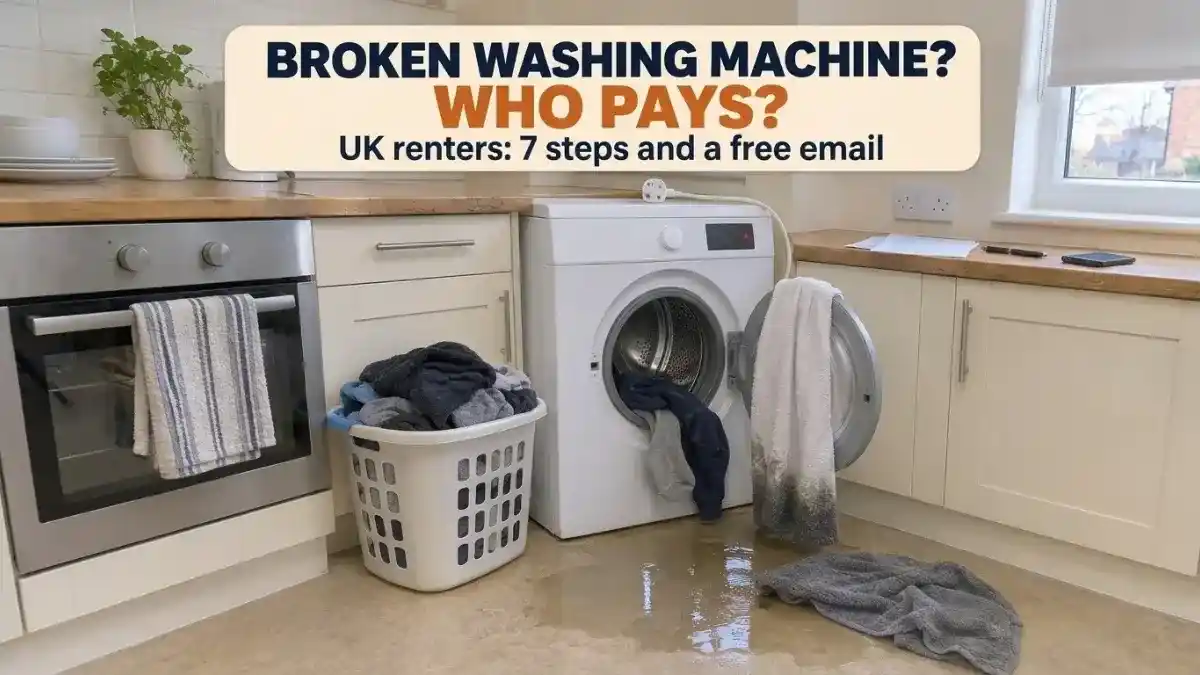
Is your washing machine suddenly broken in your rented flat, so clothes are piling up and your launderette bill is growing day by day? And you are not sure whether to phone the landlord first or call an engineer yourself to check it? Handling a broken washing machine in a rented flat can be stressful, but in a situation like this, please do not stop paying your rent in anger. This mistake could leave you without a home. And getting a repair done yourself without your landlord’s written permission could put your security deposit at risk.
The correct legal answer to this problem depends on just one thing: whose machine it is and what your tenancy agreement says.
In this complete UK guide with the help of official government and housing advice (like Shelter England and GOV.UK), we will show you a very clear way forward. In this easy guide you will learn who pays in each case, what an official email template to send your landlord should look like and how to ask for compensation for your launderette costs. This guide is mainly for England, but it also covers the different legal rules and rights in Scotland, Wales and Northern Ireland in detail.
Quick answer: In a rented flat in the UK, who is responsible for a broken washing machine depends on whose machine it was and what your tenancy agreement says. According to Shelter England, if the machine belongs to the landlord, report the fault in writing and ask them to repair or replace it. Also attach photos and proof from the inventory. If it is your own machine, the cost is yours. A tenant should never stop paying rent completely. The rules are different in Scotland, Wales and Northern Ireland.
Who Pays for a Broken Washing Machine in a Rented Flat?
First, understand one simple thing: whose washing machine is it? This answers most of the question. Then check what your tenancy agreement says about repairs. If the landlord gave you the machine, many landlords will get it fixed for you.
Landlord’s Machine or Yours? Who Pays in Each Case
Usually there are four cases here. You can find yours by looking at this table.
| Whose machine is it? | Who usually pays? | Important point |
| Landlord’s, and the agreement covers repairs | The landlord | Tell them in writing |
| Landlord’s, but the agreement says nothing | Depends on your country | See the UK rules below |
| Your own machine | You (or the shop, if it broke early) | See the Consumer Rights Act below |
| Rented from a company | The company | Check “repairs included” |
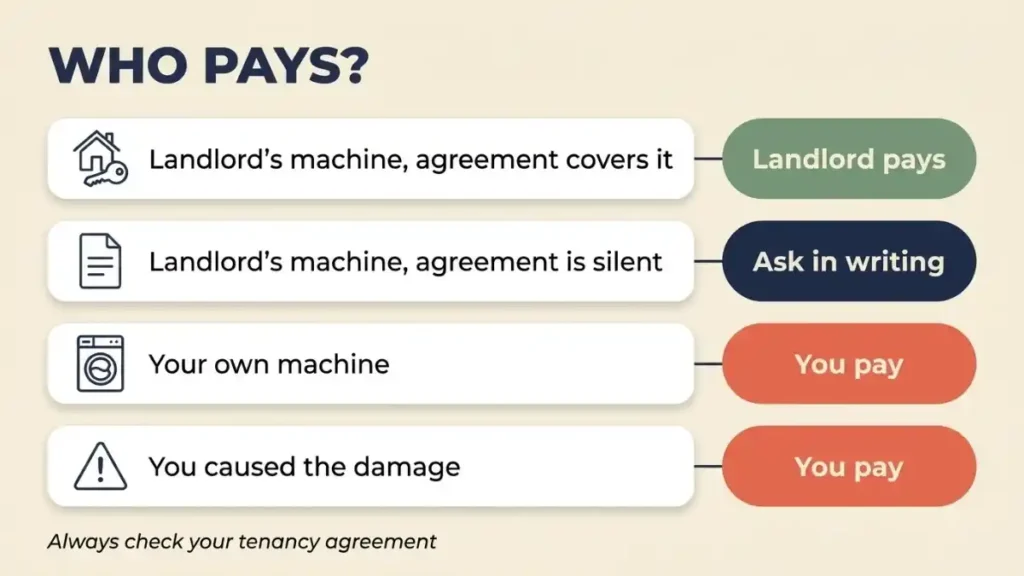
The landlord’s machine: If you took a furnished flat, the washing machine was already fitted, and your agreement says the landlord will repair appliances, then the landlord will pay the whole cost. You just have to tell the landlord straight away. If the landlord does not know anything about it, they will do nothing.
Your own machine: If you bought the machine yourself, from a shop or online, and put it in the flat of your own choice, then you will have to pay the cost yourself. But there is one big benefit here, which you get because of the Consumer Rights Act 2015. In England and the UK there is a law that shops must sell things that last a long time and do not break easily (things that are durable). The time rules are something like this:
- First 30 days: If there is any problem with the machine, you can return it and get a full refund.
- 30 days to 6 months: You can ask the shop to repair it for you. During this time the shop has to prove that the fault was not there from the start.
- After 6 months: You have to prove that the machine had a fault from the start, and that it was not your mistake. For this you need an engineer’s report, which costs a little money.
- How many years you can claim for: In England, Wales and Northern Ireland you can claim for up to 6 years if the item is not of good quality (in Scotland this time is 5 years).
If the machine is rented: In the UK some companies give out machines on monthly rent, and the monthly rent depends on the model and size. For example, an 8 kg to 10 kg machine can cost roughly £24 to £39 a month but prices change so check the company’s website. Such plans often include repairs too, so read the terms of the plan and phone the company. You do not need to phone the landlord for this.
The first tenant left it: If the machine belonged to the renter before you and it is not on the landlord’s inventory, then it may not be the landlord’s responsibility. The part below is very important for this.
How to Prove the Washing Machine Came With Your Rental
If you have an argument with your landlord, the landlord may say that this machine is not theirs at all, or that this machine is your own. To protect yourself from this, you must have proof. Collect this proof, because it will help you.
- Check-in inventory: This is the list that was made when you moved in. Look for the washing machine in it. If the washing machine is written in it, this is the strongest proof.
- Advert or listing: Take a screenshot of the website where you saw the flat, at the place where it says washing machine included.
- Emails, WhatsApp or messages: If the agent or landlord wrote anywhere that the machine comes with the flat, save that too.
- Move-in photo or video: If you took any photo or video when you moved into the flat, and the machine can be seen in it, this will make things easy for both you and your landlord.
- Tenancy agreement: Look for clauses with these words: “appliances”, “white goods”, “repairs”, “replacement”, “tenant’s responsibilities”.
Never, ever trust a verbal promise (a promise made by mouth). If the landlord or agent says to you, “Don’t worry, if the machine breaks we will get it fixed”, get this written in an email or message. Written proof is very important for this. And one more thing: when you move into the flat and when you leave it, take photos and videos both times.
What the Law Says About Appliances in England
In England there is a law called Section 11, Landlord and Tenant Act 1985. Under this law the landlord must keep these things in good repair. There are four kinds:
- The structure and the outside of the building (such as the roof, walls, windows and doors).
- Water, electricity and gas installations.
- Sinks, baths, toilets, pipes and drains.
- Heating and the hot water system.
Now listen carefully to one thing: a washing machine is not one of these installations. Let me explain with an easy example. The pipes and wires in a house are like the veins of the house. They are a part of the house. A washing machine is a separate item that works with a plug. It is called an appliance. According to Shelter, an appliance is the landlord’s responsibility only when this is written in your tenancy agreement.
So the most important thing is to read your agreement. That is the most important thing. Also check if the machine is on the inventory. This is proof that it came with the flat, and it makes it easier to ask the landlord to repair it. So it is still right to ask the landlord. Even if they say no to you, you still have the right to ask.
When You Pay (Misuse, Wear and Tear, Old Machines and Your Deposit)
There are some cases where you may have to pay the cost:
Misuse: If the problem happened because of you, the landlord can ask you for the cost. For example:
- Filling the machine with far too many clothes, or washing very heavy things again and again.
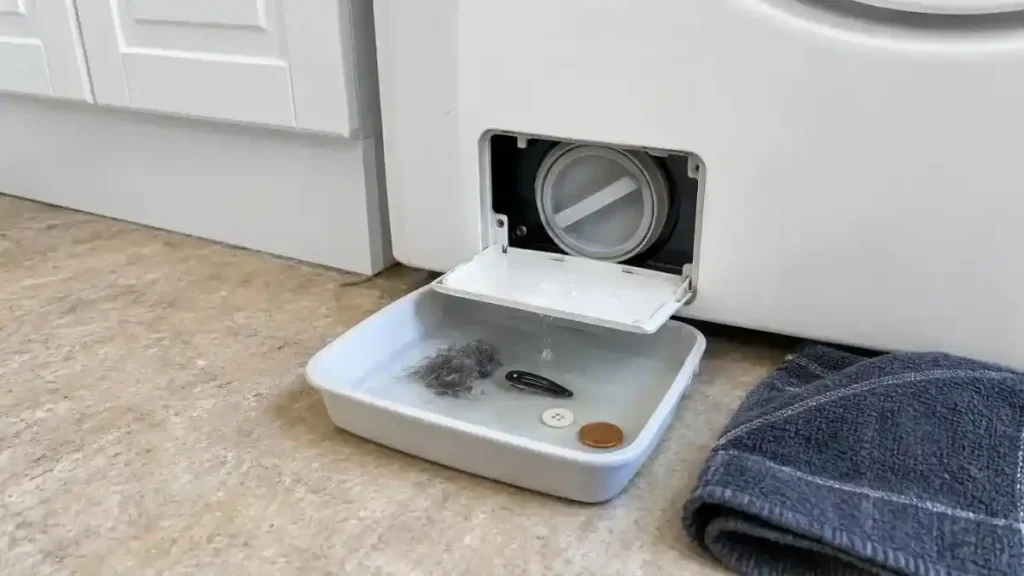
- Coins, hair clips or the wires from bras (bra wire) getting stuck in the filter.
- Never cleaning the filter, not draining the water out, and using the wrong detergent or too much detergent.
- Repairing the machine yourself, or hitting the machine hard in anger so that things break inside.
Wear and tear: Every machine has an age. If the machine is old and has only broken down with time, for example the carbon brushes wearing out, which usually happens after 5 to 7 years, then this is normal wear and tear. It cannot be called your fault, and the landlord cannot take money from your deposit for fair wear and tear.
Deposit: If your landlord says that you broke the machine and that they will take the money from your deposit, ask them for proof of this. And if you have a move-in photo in which the machine can be seen, it can become strong proof for you.
Expert guide: Never try to repair the landlord’s machine yourself. You could be blamed for it, and there is a danger from electricity too.
What to Do When Your Washing Machine Breaks (7 Steps)
Whenever your washing machine breaks, remember these 7 steps. They will be very useful for you:
- Stop and check the basics: Switch the machine off, take out the plug, and check the filter, the drain hose and the power.
- Find your paperwork: Get out your tenancy agreement, inventory and listing.
- Photograph the fault: Take a photo and a short video of whatever has broken.
- Report it in writing: Tell the landlord or agent by email or text message.
- Allow a reasonable time: After telling them, give them a fair amount of time, and then write to them again.
- Escalate if nothing happens: If you get no reply, complain about the agent to the council or the court.
- Keep every receipt and message: Keep every receipt and message safe.
Stay Safe and Check the Fault First
If the machine smells of burning, sparks are coming out of it, or smoke is coming out, switch the machine off straight away, take out the plug, and do not make the mistake of running the machine again. Write an urgent report to the landlord at once, and if a fire has started, call 999.
Scotland’s fire safety campaign also says that fires caused by washing machines, tumble dryers and dishwashers happen every week, so register your appliances and keep checking for product recalls.
If you are safe, do these checks in 2 minutes. Many times the problem is small, so check these things before you open the machine:
- Socket and fuse: Plug in another small thing, like a mobile charger, and see if it works. Also look at the fuse in the plug.
- Fuse box switch: If a trip switch (RCD) has fallen in the fuse box, put it up once. If it falls again, do not keep switching it back on, and tell the landlord about it.
- Door lock: If the machine door will not open, switch the machine off and wait a few minutes. Some machines have a small emergency release near the filter. Look at your manual.
- Drain filter: There is a small cover at the front bottom of the machine. Before opening it, put a towel or tray underneath, and then open it. Water will come out of it, and the filter will be clean.
- Drain hose: Check that the pipe is not bent or squashed anywhere.
- Error code: If a code shows on the screen, take a photo of it and look in the manual or on the company’s website.
If the problem is not solved, take photos and videos of it, add your own voice to them, and also write down since when the problem has been there. This will be useful when you tell the landlord.
Report It in Writing (Free Email Template)
Never report it to the landlord by phone, because the landlord can deny it later. So send an email in writing. That gives you proof.
In the email write these things: the address of the flat, when the problem started, the make and model of the machine, what the problem with the machine is, what you have checked, photos and videos, and that the machine is on the inventory or listing. At the end, write the date by which you want a reply.
Subject: Broken washing machine at [full address] – repair needed
Dear [Landlord or agent name],
I am writing to report that the washing machine at [full address] stopped working on [date].
Make and model: [as shown on the machine]
Problem: [for example: it will not drain / the door will not open / it leaks from the bottom / error code ___]
What I have checked: I switched it off and unplugged it, then checked the plug, the fuse, the filter and the drain hose. The problem is still there.I have attached photos [and a short video] of the problem.
The washing machine came with the flat. It is [listed in the inventory / shown in the property advert / mentioned in clause ___ of my tenancy agreement]. Please could you arrange a repair, or a replacement if it cannot be repaired?
[Only if it is leaking: Because of the leak, please arrange this within 24 hours.]
Please reply by [date, 3 days from today] to confirm you have received this, and tell me by [date, 7 days from today] when an engineer can visit. I am happy to give access with reasonable notice on [days and times].
I have not tried to repair the machine, and I will not book anyone without your written permission. Until it is fixed I have to use a launderette, and I am keeping the receipts.
I am putting this in writing so we both have a record.
Kind regards,
[Full name]
[Phone number]
If your landlord or agent does not reply to the first email, send this reminder after 7 days. Just like before, fill in your own details in the [brackets].
Subject: Second request – broken washing machine at [full address], first reported on [date]
Dear [Landlord or agent name],
I first reported the broken washing machine at [full address] on [date]. My email is below. I have not had a reply or a repair date.
The machine is still not working. It is [listed in the inventory / shown in the property advert / mentioned in clause ___ of my tenancy agreement]. Please could you confirm by [date, 7 days from today] when it will be repaired or replaced.
The delay is costing me about £[amount] a week at the launderette, and I have kept every receipt. Please could you either cover these costs or agree a temporary rent reduction until the machine is fixed. I am still paying my rent in full and on time.
I would like to sort this out with you directly. If I do not hear back by [date], I will [make a complaint through the letting agent’s complaints process / contact the council’s private renting team for advice] and ask for compensation for the costs and trouble this has caused me.
Kind regards,
[Full name]
[Phone number]
How Long Should a Landlord Take to Fix It?
The law does not give any fixed number of days for a washing machine. In the UK the rule is that the landlord is given a reasonable time for a repair, and this time depends on how serious the problem is. According to Shelter’s guide, in an emergency, such as a boiler breaking down in winter, a reasonable time can be 24 hours.
A washing machine does not usually count as an emergency, but this does not mean the landlord can disappear for months. In council and housing association homes, for example, an estimate of 24 hours (emergency), 7 days (urgent) and 28 days (routine) is used. For private rent this is not the law, but it is a good estimate.
In practice, go by this (this is my estimate, not a law):
- 2 to 3 days: The landlord or agent will reply to you.
- 7 days: They should arrange an engineer or tell you the plan.
- 2 to 4 weeks: The repair is done or you get a replacement, especially when a spare part has to be ordered.
If the problem is bigger, ask the landlord for less time and write “Because of the leak, please arrange this within 24 hours.” And this time starts when you tell the landlord, so remember the date of your first email.
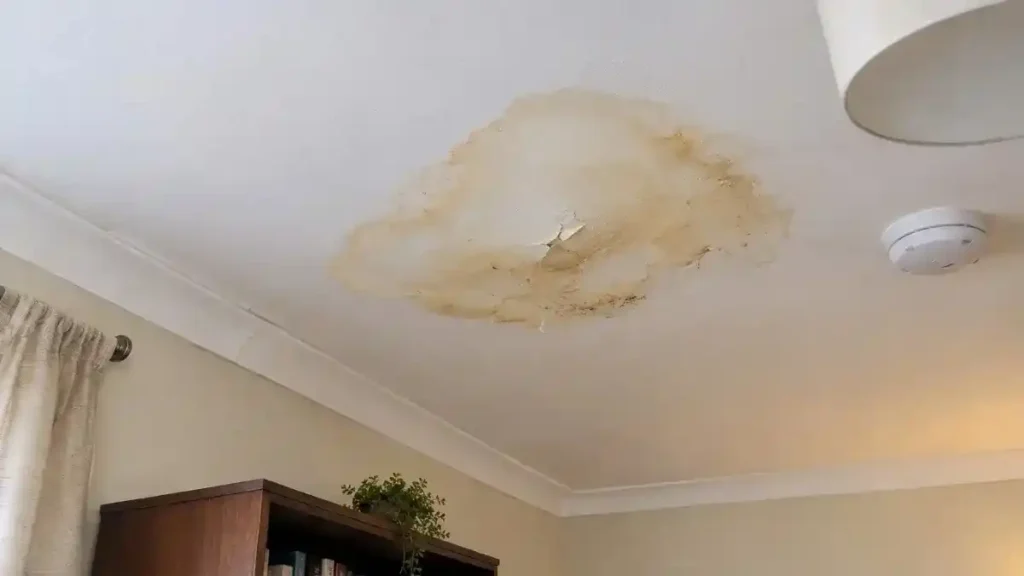
Leaked Into the Flat Below? Water Damage and Insurance
If water leaks from the machine and goes down to the flat below, do this quickly:
Turn off the water: Switch the machine off and turn off its tap or isolation valve. If needed, turn off the flat’s main water supply too, and clean up the water, stopping as much water as you can. Tell the landlord or agent straight away, and tell the neighbour below quickly too.
Photo and video: Take photos of the floor, the machine and the stain below.
Look at your insurance policy.
The most important question is: who will pay now? This depends on the case. Usually two policies are looked at here: the landlord’s or the building’s insurance, and your own contents insurance (if it has liability cover). They look at what caused the leak, for example:
- The machine itself was old or faulty, you made no mistake, and you had already told the landlord but they did not get it repaired. Then this can go to the landlord’s side, and the landlord will also have to make the insurance claim for it.
- If it was your mistake, for example you ran the machine even though the filter was blocked, or you left the tap open, then the responsibility can come to you.
- If the problem is with the building’s pipes or shared parts, the responsibility belongs to the landlord or the freeholder.
What If Your Landlord Won’t Fix or Replace the Washing Machine?
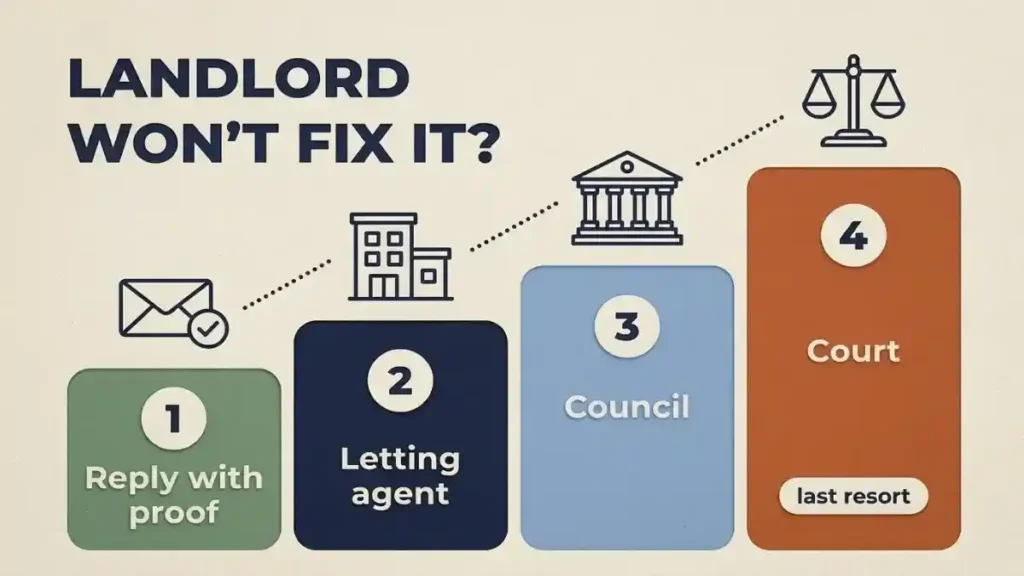
First, one important thing: if, according to your tenancy agreement, the machine is not the landlord’s responsibility, then they can refuse to get it repaired. But if it is their responsibility and they still do not listen to you, follow the steps given below. The details of each step are given below:
How to Escalate to the Letting Agent, Council or Court
When the landlord does not listen to you, you do not have to go straight to court. There are some specific steps for this that you must follow:
- Send a reminder: After 7 to 14 days have passed since your first email, send a reminder email.
- Complain to the letting agent: If you did not take the flat directly from the landlord but through an agent, first use the agent’s own official complaints policy. If the agent gives no reply for 8 weeks or does not solve the problem, you can make a free complaint to their redress scheme (such as The Property Ombudsman or Property Redress Scheme). This scheme can order the agent to pay a fine or compensation.
- Council: You can write to the local council’s private renting team. But remember, the council is usually active only when the problem is a big danger to health or safety (such as damp, bad wiring, or a water leak that reaches an electric switch). The council does not take quick action just because a washing machine is broken, unless there is some safety risk.
- PRS Landlord Ombudsman: Under the UK government’s new Renters’ Rights Act, a new Ombudsman is being set up in England. When it is fully active, renters will be able to complain to it directly. So you should keep checking GOV.UK for the start date.
- Court (the last way): This is the very last option. First a “Letter Before Claim” is sent to the landlord (giving them a fair time to reply). If things still do not work out for you, an online case can be made in court. But for a small washing machine, going to court is often not needed, because the landlord knows they are wrong, so they often agree before that.
Can You Withhold Rent or Ask for a Rent Reduction?
The answer is: absolutely not! Never stop your rent in anger or for any reason, or the landlord can make you leave the flat. The landlord can throw you out on the basis of Section 8 for not paying rent, so the law says never stop your rent.
Instead, ask in writing for a temporary rent reduction. That means you can ask for the rent to be lowered until the machine is fixed. Renters have different opinions on this: some say there is no chance of it, while some renters say a discount is possible. But this depends completely on the landlord.
Compensation, Laundry Costs and Fixing It Yourself
While your washing machine is broken and you are getting your clothes washed outside, keep every receipt safe, with its date, the address of the laundry shop, and how much money it cost. Then you can ask the landlord for compensation for this cost. According to Shelter, if the landlord has delayed getting the machine repaired without a good reason, you can ask for compensation for the trouble this caused, your launderette costs, and things damaged by water. You can make this claim any time within 6 years. But keep one thing in mind: this is a right to ask, and it is not guaranteed that you will get the money.
Fixing it yourself:
Calling an engineer or getting a repair done yourself without written permission can be risky. So the right way is to first get written permission from the landlord by email, and agree whether the landlord will pay the money themselves or whether it will be taken off the next rent. If there is no written proof, the landlord can refuse to pay.
Buying a new machine:
Before buying a new machine, ask your landlord for permission, and ask whether they will allow you to remove the old machine. If you are buying the machine yourself, keep these things in mind:
- Capacity: 7–8 kg is enough for 1 to 2 people, and 9–10 kg is better for a home of 4 people.
- Energy rating: New A or B rated machines use less electricity and water.
- Useless features: You do not need a machine with 20 different features, because usually only 2 or 3 features get used.
- When you leave the house: This is your own machine, so agree with the landlord before you move out that you will take it with you.
Washing Machine Rules in England, Scotland, Wales and Northern Ireland
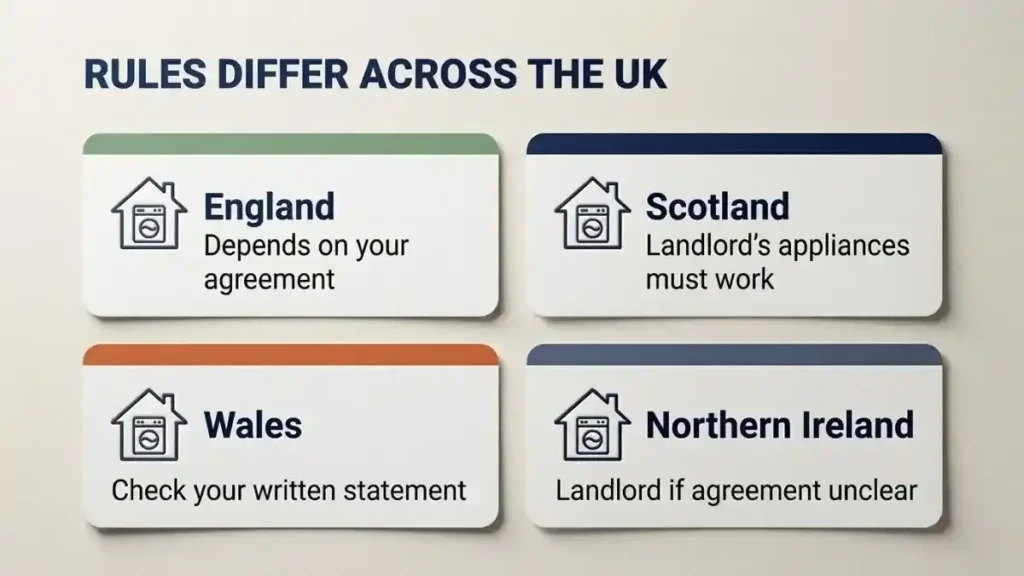
In the UK, the laws for landlords and tenants are not all the same. Your rights are a little different depending on which part of the UK you live in, so first of all, see which part of the UK you live in.
Do the Rules Differ Across the UK?
Yes, the rules are different in all four parts of the UK, so first see where you live.
| Country | Rule | Help |
| England | Depends on your agreement | Shelter, Citizens Advice |
| Scotland | Landlord’s appliances must be in working order | Shelter Scotland, tribunal |
| Wales | Depends on your written statement | Shelter Cymru, Citizens Advice Cymru |
| Northern Ireland | Usually the landlord, if the agreement is silent | Housing Rights, nidirect |
Each country is explained in detail below:
England Depends on Your Tenancy Agreement
In England the most important thing is your Tenancy Agreement. Section 11 (Landlord and Tenant Act 1985) does not include appliances like a washing machine, so the landlord is bound only when it is written in your agreement.
Look in your agreement to see if it says: “Landlord will repair or replace appliances”. If it says this, you can write to your landlord and tell them. If nothing is written, you can still ask the landlord for a repair. It is not a must that every landlord will get it fixed, but many landlords do get it fixed.
Scotland Requires Landlord-Provided Appliances to Be in Working Order
Scotland has a “Repairing Standard” (Housing (Scotland) Act 2006). According to this, the landlord has to make sure the home meets this standard.
For appliances, the rule is that the landlord does not have to give you appliances, but if they do give you one, it must be in “reasonable state of repair and in proper working order”, and a washing machine is included in this. If the landlord gave the machine, the machine’s condition is looked at more than its age.
Wales Depends on Your Written Statement
In Wales, the “Occupation Contract” now runs instead of the old “Tenancy Agreement”, and the landlord must give you a Written Statement. About a washing machine, these are the points:
- According to Citizens Advice: If the landlord has written in the contract that they will repair appliances (such as a washing machine), then they are bound by this.
- Fit for Human Habitation: By law the landlord must make sure the home is fit to live in. If a washing machine fault causes a big danger (such as damage from electricity or water), this rule becomes active.
- Notice must be given: Before coming to the home to do a repair or check the landlord must give you proper notice usually at least 24 hours. Apart from this, the landlord cannot push their legal repair duty onto the renter by force.
Northern Ireland Usually Makes the Landlord Responsible if the Agreement Is Unclear
In Northern Ireland the rules for renters are much better and easier. At the start of the tenancy, the landlord has to give you a written notice with the main details of the tenancy, so check what it says about repairs.
If the contract does not clearly say anything about the washing machine, then according to the law of nidirect and Housing Rights, the landlord is responsible for all the electrical appliances they provided with the tenancy. Also remember 2 things:
- If you have a dispute with the landlord, Housing Rights may be able to help you with advice and mediation.
- Before complaining to the local council, do talk to an expert (such as Advice NI or Housing Rights) first, so you know all your options.
Washing Machine in a Rented Flat FAQs
Who is responsible for a washing machine in a rented property?
If the landlord gave you the machine, your tenancy agreement will tell you who should get it repaired. If the machine is your own, you will have to pay for the repair yourself.
Does a landlord have to provide a washing machine?
No, usually a landlord does not have to give a machine. If they have given one, check your agreement to see who has to get it repaired.
What if the washing machine isn’t mentioned in my tenancy agreement or inventory?
Look for other proof, like the property advertisement (its ad), emails or photos. Then ask the landlord in writing who is responsible for the repair.
Does my landlord have to replace a broken washing machine?
Not every time, because the landlord also has the option to repair it. If the machine cannot be repaired and it is the landlord’s, ask them by email for a safe, working machine.
How long does a landlord have to fix a washing machine?
In England there is no fixed number of days for appliances. Only “reasonable time” is written. According to most guides, a reply should come in 1 week and the repair should be done in about 4 weeks. This is an estimate, not a law.
Can I withhold rent if my landlord won’t fix the washing machine?
No! If you stop your rent, you could be at risk of being thrown out of your home. Instead you can ask in writing for a temporary reduction in rent.
Can I claim laundrette costs from my landlord?
You can ask, but it is not a must for the landlord to say yes. Keep every receipt safe and ask in writing.
Can my landlord evict me for asking for repairs?
From 1 May 2026 a landlord cannot throw you out without a reason (section 21 / no-fault notice). But they can use other legal reasons, so always ask for repairs in writing and keep your proof safe.
Who pays if my washing machine floods the flat below?
Switch off the water at once, take out the machine’s plug and tell the landlord. Every case is different so check your own contents insurance and the landlord’s insurance.
Who pays if my own washing machine breaks in a rented flat?
If the machine is your own, you will have to pay, not the landlord. Check your warranty. In England you can claim from the shop within 6 years of buying, but after 6 months you will have to prove that the fault was there from before.
Written by Faizan Ali
Digital Content Creator & UK Rental Specialist
Faizan specializes in UK tenancy rights, deposit-safe solutions, and practical home management for renters across England, Scotland, Wales, and Northern Ireland.
Verified Legal Sources & References
This guide is fact-checked against official UK housing regulations and statutory guidance:
- Government & Legal Frameworks: GOV.UK (Renters’ Rights Act & HHSRS), Housing (Scotland) Act 2006, Renting Homes (Wales) Act 2016, nidirect (NI Tenancy Regulations), Consumer Rights Act 2015.
- Tenant Advisory Authorities: Shelter England & Scotland, Citizens Advice, Housing Rights NI, Property Redress Scheme.